
About Language Quiz
A free German course from A1 to C2 that respects your time and your privacy: no account, no ads, no paywall, and nothing about you leaves your browser.
The project
Language Quiz started in June 2026 as a small quiz for the hardest habit in German — der, die, das — and grew, release by release, into a complete course: stepped lessons with audio at every level, fill-in exercises, dictation, flashcards, a word library of nouns and verbs, printable workbooks, and the beginnings of an illustrated story mode. The changelog tells that story in full.

A few convictions shape every decision. Learning beats testing, so nothing is locked and every level is open from the first visit. Small slips — a missing umlaut, a forgotten full stop — don't sink an answer, because that is how real practice works. And the whole thing stays free: your progress lives in your own browser, the audio is pre-recorded rather than metered, and there is no account to create because none is needed.
Privacy is not a feature here, it is the architecture. No cookies, no identifiers, no consent banner — only anonymous, aggregate statistics, as the settings page explains in plain words.
How AI is used
In the spirit of saying plainly how things work: this course is made with the help of AI tools, and you should know where.
- Pictures — every illustration is generated with Google's Gemini image model, from prompts and a style I write and choose.
- Audio — the German you hear is spoken by Google Cloud Text-to-Speech neural voices, not by recorded human speakers.
- Lessons and exercises — Anthropic's Claude helps me draft explanations, example sentences and questions; I decide what goes in, and check and correct it.
- Code — I write the app with Claude Code, an AI coding assistant.
None of it runs on you: no AI reads your answers or your progress, and the speaking exercise hands off to an assistant you choose. AI still gets things wrong, and some slips will get past me — if you spot one, please tell me.
The mission
Most language courses assume one kind of learner: start at page one, proceed in a straight line, pass the test, turn the page. Plenty of people don't learn that way — and too many of them conclude the problem is them. It isn't. Part of my mission with Language Quiz is to open German up to exactly those people.
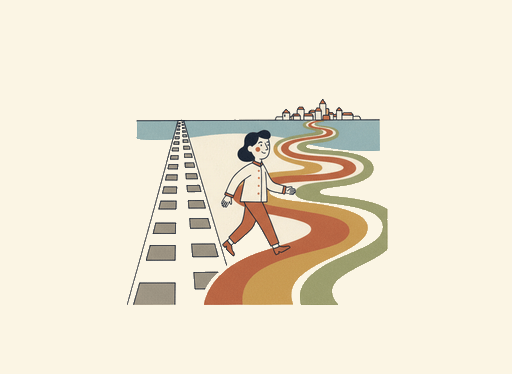
That is why the course refuses to be a single straight line. You can read a lesson, listen to it, drill it as flashcards, type it, speak it, follow it as an illustrated story, or print it and work on paper — the same German, offered in as many shapes as there are ways of learning. Jump levels, circle back, skip what bores you: the course adapts to how you learn, not the other way round.
And it runs on free, open technology end to end, so it can stay free for every learner. Access to a language should not depend on a subscription.
Accessibility
Opening German up has to include people who use a screen reader, a keyboard instead of a mouse, or who can't rely on colour, sound or fast reading. The course is built to work for them too, aiming at the WCAG 2.2 AA guidelines:
- Screen readers — right and wrong answers, corrections and results are read out, and German is marked as German, so a corrected sentence is spoken in a German voice rather than an English one.
- Keyboard — every exercise, the card deck and every panel work without a mouse, with a "skip to content" link and focus that never gets lost when the screen changes.
- Your own pace — in settings, "Wait for me" stops the exercises moving on by themselves; nothing is timed.
- Hearing — a setting adds a "Show the text" button to dictations and listening exercises, for anyone who can't hear the audio.
- Seeing — text meets the contrast guidelines, and noun genders are told apart by their underline as well as their colour.
- Motion — "Calm effects" in settings, or your device's "reduce motion" setting, turns off the confetti, shakes and pulses.
I test this myself, but not with every assistive technology. If something gets in your way, please tell me; I treat that as a bug, not a wish.
About me
Hi — I'm GDI. I moved to Germany in 2019, and I've been learning German the hard way ever since: every classroom course from A1 to B1.2, most of them more than once, plus the big language apps and a long list of other online resources. And still I struggle. Every one of those tools lost me the same way — the rigid forward march, one page after the next, until the interest drained away and I stopped. But stopping isn't an option when you live here. I need to keep learning.
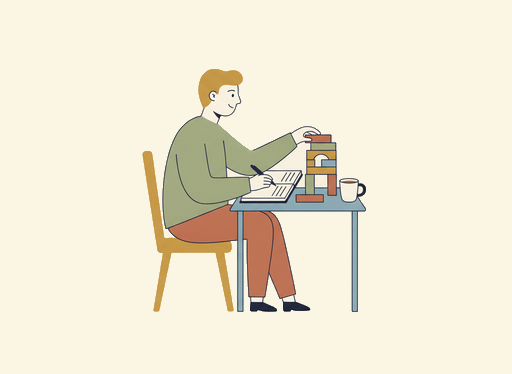
So I'm building the course I needed: something that works on its own and alongside a classroom course, for keeping the language alive between lessons. I'm also its first test subject — nearly every interaction in the app gets tried on me first, kept when it works and rebuilt when it doesn't, so the app gets better while I learn. I hope it helps more people in my situation, and in situations I haven't imagined yet.
I build this on my own — the code, the course content, the drawings and the audio, with the AI tools described above. If something is wrong, confusing or missing, I genuinely want to know: the app has grown out of exactly that kind of feedback. Write to me — every message gets read.