Feature: Drei Buchstaben aus Erlangen
Press play and listen as many times as you like — the transcript appears once you check your answers.
B1.2 · 16 of 43
Lesson · 2 rules · you practise after the first one
Ein Radiofeature von etwa drei Minuten über eine deutsche Erfindung, die jeder benutzt und kaum jemand kennt: das MP3-Format. Entwickelt wurde es in den achtziger und neunziger Jahren am Fraunhofer-Institut in Erlangen, unter Leitung von Karlheinz Brandenburg, der sein Verfahren Hunderte Male an einem einzigen Lied testete, bis es natürlich klang. Das Feature erklärt, wie Musik verkleinert werden kann, ohne dass das Ohr es merkt, warum die Erfindung 1995 ihren Namen bekam, wie sie die Musikindustrie veränderte und warum die Erfinder lange nichts daran verdienten. Die Fakten sind real und geprüft; die Sprecher sind erfunden. Sprachlich hörst du, was du zuletzt geübt hast: das Passiv mit Modalverb (Musik muss verkleinert werden; die Datei kann in Sekunden übertragen werden; es durfte nicht kopiert werden) und die Wortbildung mit Suffixen (die Erfindung, die Entwicklung, die Genauigkeit, die Freiheit, die Wissenschaft, der Künstler, der Hörer). Die Fragen prüfen Zahlen, Technik und Formen.
Press play and listen as many times as you like — the transcript appears once you check your answers.
Presenter: Everyone has them on their phone, they have been downloaded billions of times, and almost nobody knows they come from Franconia: MP3 files. The format was invented at the Fraunhofer Institute in Erlangen, a town of a hundred thousand between Nürnberg and Bamberg. Mr Vogel, you prepared the story for a museum. Where does it begin? Expert: In the eighties, with a problem. A young electrical engineer, Karlheinz Brandenburg, was to solve a question in his doctoral thesis: how can music be sent over a telephone line? A minute of music in CD quality needed ten megabytes at the time; the line managed a twelfth of that. So the music had to be shrunk to a twelfth without anyone hearing it. Presenter: How does that work? Expert: By exploiting how the ear works. Human hearing is not perfect: quiet sounds right next to loud ones are not heard, very high sounds neither. What is not heard need not be stored. Brandenburg's method calculates which parts of the music can be left out and stores only the rest. That needs precision and very many tests, because as soon as something wrong is left out, it sounds tinny. Presenter: And it was tested with a single song? Expert: With many, but one song became famous: a recording by the singer Suzanne Vega, only her voice, without instruments. A single voice is the hardest thing for a method like this, because every error is immediately audible. Brandenburg listened to the song hundreds of times until it sounded natural. The development took almost ten years. In 1992 the method became an international standard, and in 1995 a name had to be found for the files; the researchers voted, and the extension .mp3 won. Presenter: And then? Expert: Then happened what nobody in Erlangen had planned. With the internet a song could be sent around the world in minutes, and that was done, millions of times, mostly without paying. The music industry lost half its revenue within a few years; the songs were not allowed to be copied, but it was done anyway. The inventors themselves long earned nothing, because they were scientists and not traders. Only when the patents had to be used in devices and programs did licence fees flow, in the end hundreds of millions of euros to the institute. Presenter: What remains of the invention today? Expert: The idea. Streaming, podcasts, every call over the internet: everywhere what cannot be heard is left out. The three letters from Erlangen enlarged the listeners' freedom and changed the artists' lives, and Karlheinz Brandenburg still says to this day he only wanted to solve a problem in his doctoral thesis.
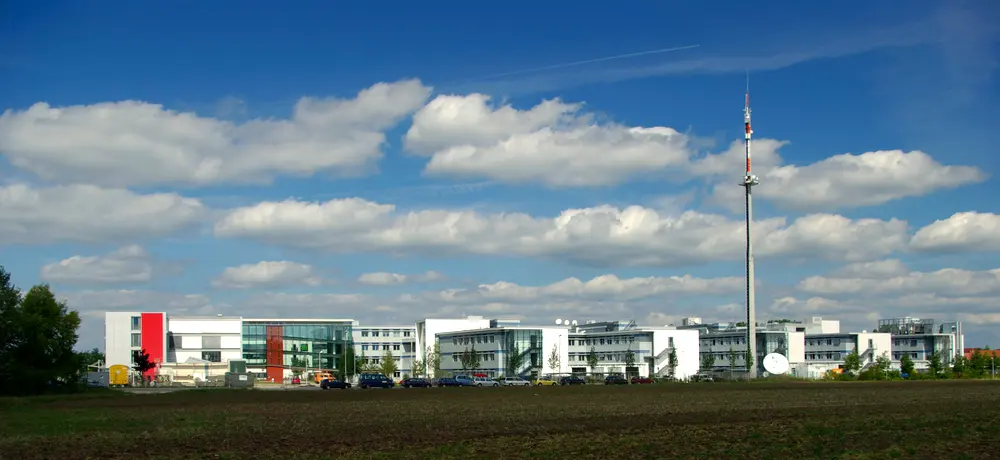
Photo: Arneb, CC BY-SA 3.0, Wikimedia Commons
Exercise
Hören: Drei Buchstaben aus Erlangen · B1.2
No single question is on screen — the report is about the whole exercise.
Reports go to the forum, where anyone can read them and the answer is kept for the next learner. To send one — and to be told when it is answered — sign in first. It takes one email, and no password.
Signing in lets us reply to your report, and shows you the answer the next time you are here. We email you a one-time link: no password, and nothing is shared with anyone.
Everything works without an account. Signing in backs your progress up, carries it to your phone, and lets you post on the forum.
One email, no password. We email you a one-time link: no password, and nothing is shared with anyone.