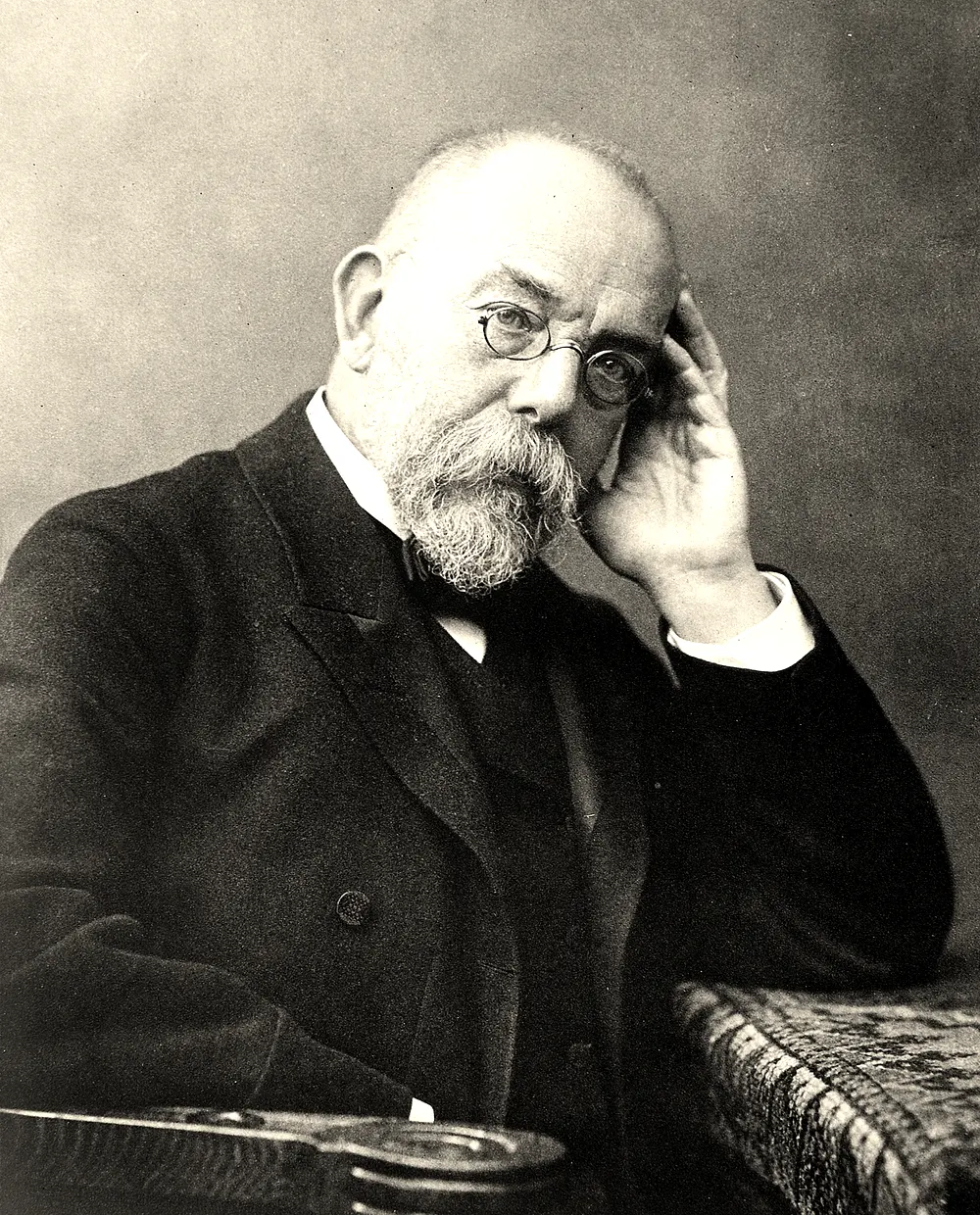
Robert Koch was born in 1843 in Clausthal in the Harz, the third of thirteen children of a mining official. He studied medicine in Göttingen, married in 1867 and afterwards worked as a doctor in small places, lastly in Wollstein in the province of Posen, where he treated farmers, children and cows. For his thirtieth birthday his wife gave him a microscope. It was the most important present of his life.
While he treated patients by day, in the evenings he examined, in a room next to the practice, the blood of animals that had died of anthrax. At the time most doctors believed diseases came from bad air or from the body itself. Koch found small rods in the blood, cultivated them, injected them into mice and saw that the mice fell ill. In 1876 he published the proof: one disease, one pathogen. Before anyone knew him, the country doctor had changed medicine.
After he had been called to Berlin, he looked for the pathogen of the disease of which every seventh European died in the 19th century: tuberculosis. The bacterium was tiny and could not be stained, until Koch found a new method after months of experiments. On 24 March 1882 he gave a lecture to the Physiological Society, showed his preparations and said the sentence that made him famous: tuberculosis is caused by bacteria. After he had finished, the room stayed silent for a long time. Nobody asked a question. Everyone had understood what they had seen.
Koch formulated rules that still apply today: a pathogen must be found in every patient, it must be possible to cultivate it, and it must cause the same disease in a healthy animal. In 1883 he travelled to Egypt and India and found the pathogen of cholera. With the Frenchman Louis Pasteur, who was working on vaccines at the same time, he quarrelled publicly and for years; more than language separated the two men, but together they created modern bacteriology.
In 1891 an institute for infectious diseases was founded in Berlin, of which Koch became director. In 1905 he received the Nobel Prize for medicine. He died in 1910 in Baden-Baden. The institute has borne his name since 1912, and since the pandemic everyone in Germany knows it: the Robert Koch Institute, which counted the figures while the country stayed at home.