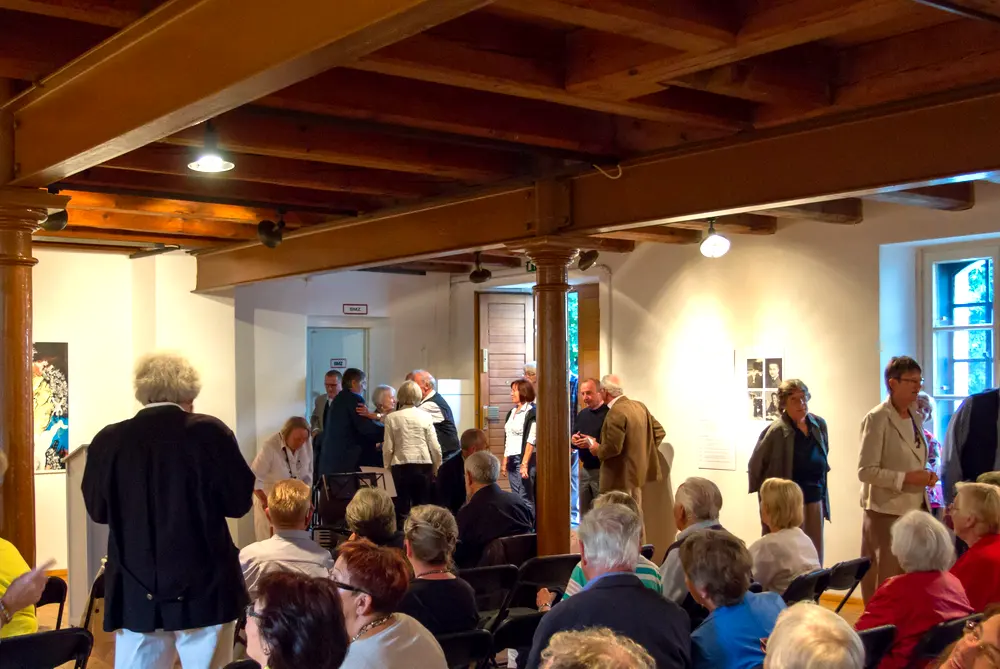
Anyone walking through a German city on a Sunday evening can observe a ritual that regularly baffles visitors from other countries. At a quarter past eight the streets empty, in the pubs the conversations grow quieter, and on the screens above the bars the same title card appears: crosshairs, two eyes, the word Tatort. Then for ninety minutes people are silent together, investigate together and at the end argue about whether the case was any good. Eight to twelve million people watch every week, more for special episodes; no other television format in Europe has held the same slot for more than fifty years.
It began on 29 November 1970 with a Hamburg detective who in Taxi nach Leipzig investigates a murder in the GDR, and with an embarrassment. The ARD, an association of regional broadcasters, needed a crime drama that could keep up with the successful rival format on ZDF, but had no central editorial team that could have produced it. So it did what it does with everything: it shared out the task. Each broadcaster got its own detective in its own city, shot its own episodes and delivered them into a shared series. What began as a stopgap is the basic idea to this day: the Tatort is federal like the country it is set in.
That explains why it can be so varied. In Munich the same two detectives have investigated since 1991, calm, grey and without a single punchline; in Münster a forensic pathologist and a detective who cannot stand each other solve their cases as comedy, and these episodes regularly reach the highest ratings of the series, most recently over thirteen million. Dortmund is dark, Vienna sharp-tongued, Kiel was for years a case apart. Viewers who love the Münster pair simply switch off for the Munich ones, and vice versa. That the series can take this is because it is not a serial: every episode is a self-contained film with its own script, its own director and usually its own attitude. Over 1,300 such films have been made by now, a television history of the Federal Republic in murder cases.
Among the rules is that the detectives are allowed to age. Anyone who has watched the Munich investigators since 1991 has seen them go grey, has lived through separations, illnesses and the death of colleagues with them, and that in real time, over more than three decades. No other format offers its audience the same faces for so long. Conversely, a detective's farewell becomes an event that newspapers report on for pages, and the question of who follows becomes the casting question of the country.
For that is probably what it is really about. The cases are exciting enough, mostly at least, but exciting crime dramas exist everywhere. What sets the Tatort apart is its ambition to speak about the present: unemployment in the Ruhr, the care crisis, right-wing extremism, the housing shortage, drones, old-age poverty. The series has often picked up a topic earlier than the news, and many a case has triggered a debate in the Bundestag the Monday after. One can accuse it of occasionally lecturing, and of the murderers in Münster being strikingly often Münster worthies. But that is simply the price for a mass audience exposing itself every week to a topic it would otherwise click away.
Watching together is no accident but part of the format. In many cities there are pubs that show the Tatort like a football match, with a screen, a quiz and regulars, and on social networks people comment, mock and guess in parallel. Sunday evening, when the weekend ends and the week has not yet begun, is the ideal moment for it. Sociologists speak of one of television's last campfires: a moment in which a large part of a country sees the same thing and can talk about it the next morning.
Whether that survives the streaming libraries is the question nobody at the broadcaster likes to hear. Yes, the Tatort is available there too, and many now watch it on Tuesday; the Sunday ratings are slowly falling. But a campfire that anyone can light whenever they like is not really one any more. Perhaps that is why the ritual is tougher than the figures suggest: whoever watches it alone on Tuesday has seen it; whoever watches it in the pub on Sunday was there. That, for all the mockery of the crime-drama republic, is a difference.