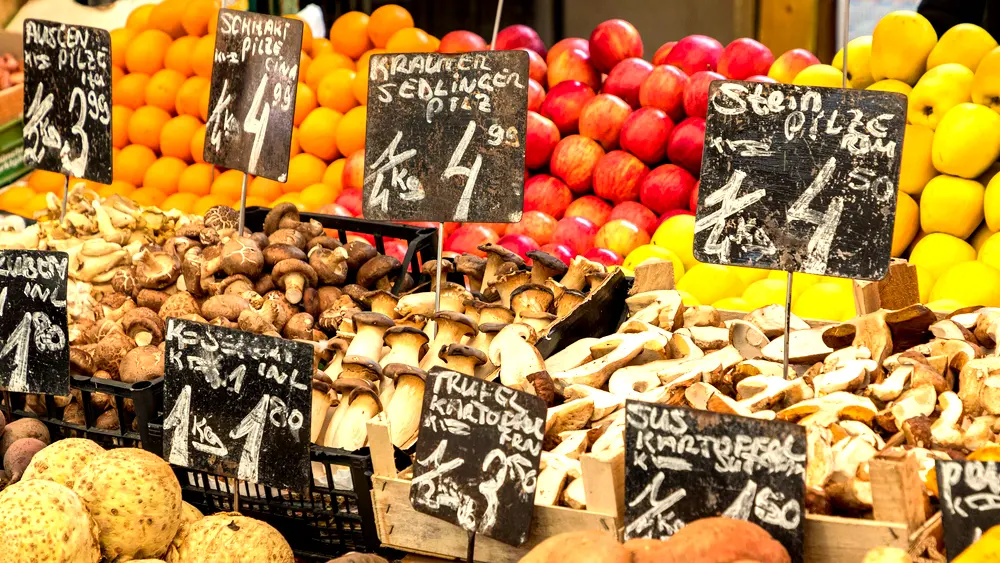
When Austria joined the European Union on 1 January 1995, its accession treaty contained a document that exists in no other treaty of the Union: Protocol No. 10 on the use of specifically Austrian expressions of the German language. Its annex lists 23 words, all from the kitchen. Beiried, Eierschwammerl, Erdäpfel, Faschiertes, Fisolen, Grammeln, Hüferl, Karfiol, Kohlsprossen, Kren, Lungenbraten, Marillen, Melanzani, Nuss, Obers, Paradeiser, Powidl, Ribisel, Rostbraten, Schlögel, Topfen, Vogerlsalat, Weichseln, and next to each what one says in Germany: roast beef, chanterelles, potatoes, minced meat, green beans, cracklings, hip, cauliflower, Brussels sprouts, horseradish, fillet, apricots, aubergines, round, cream, tomatoes, plum jam, currants, rib roast, leg, quark, lamb's lettuce, sour cherries. The protocol stipulates that the Austrian expressions have the same status and the same legal effect in the Union's legal acts as the German ones. People made fun of it, in Vienna as in Brussels. Yet it was the first time a treaty under international law recognised what linguists had been saying for decades: German has not one standard but several.
The technical term for this is pluricentric, and it describes a state that speakers of English take for granted and speakers of German consider an imposition. Nobody in London would claim that an American who says truck instead of lorry speaks dialect or wrong English; he speaks American English, a standard form of its own with its own dictionaries. For German the same did not apply for a long time. The dictionaries were made in Germany, and whatever was different in Vienna or Zurich received a label in them, 'österr.' or 'schweiz.', marking it as a deviation, while the German-German form remained unlabelled, as if it were the language itself. That a Viennese says Jänner, heuer, Spital, Matura and Sessel for what a Berliner calls Stuhl, that he forms the perfect ich bin gesessen and says das Cola, counted as endearing and a little provincial. That the Berliner conversely says things nobody in Vienna would say did not occur to him, because his form was in the books.
Switzerland answered the question in its own way, namely practically. It has not written ß since the thirties, because typewriters that also had to manage French and Italian had no room for the key; Straße became Strasse, and nobody misses anything. It took from French what was practical and developed its own forms in the process: Velo, Billett, Trottoir, Coiffeur, but also parkieren, grillieren and das Tram. It says Spital, Matura and allfällig where Germany says Krankenhaus, Abitur and etwaig. And in letters and newspapers it writes a German every German understands and yet immediately recognises as Swiss, because it avoids the preterite, prefers the perfect and uses words considered old-fashioned in Hamburg. The Swiss themselves call it Schriftdeutsch, written German, and they call it that because they almost only write it: in everyday life everyone speaks dialect, from the Federal Council to the cashier, which gives the country a bilingualism within one language that regularly leaves Germans at a loss.
In 2004, after years of work by researchers from all three countries, the Variantenwörterbuch des Deutschen appeared. It records some twelve thousand words and phrases not used the same way throughout the language area, and it does something no dictionary had done before: it labels all three varieties equally, including the German-German one. Whoever looks up Aprikose there finds the label 'D', just as Marille carries 'A'. That was more than a lexicographic decision. It was the renunciation of the idea that somewhere a correct German exists from which the others deviate. There are three, and alongside, as the dictionary also records, forms in South Tyrol, Liechtenstein, East Belgium and Luxembourg that nobody asks whether they belong.
Why do Germans of all people find it so hard to accept? Probably for the same reason the English long looked down on American English: whoever forms the majority takes its habits for the norm. Eighty million against eight and five. But language is not democracy, and majority is not correctness. Protocol No. 10 was in this respect less ridiculous than it seemed. It wrote 23 words into a treaty to secure a principle that does not fit into treaties: that the Marille is not a wrong apricot but a correct Marille, and that a country has the right to say in its own language what it eats.