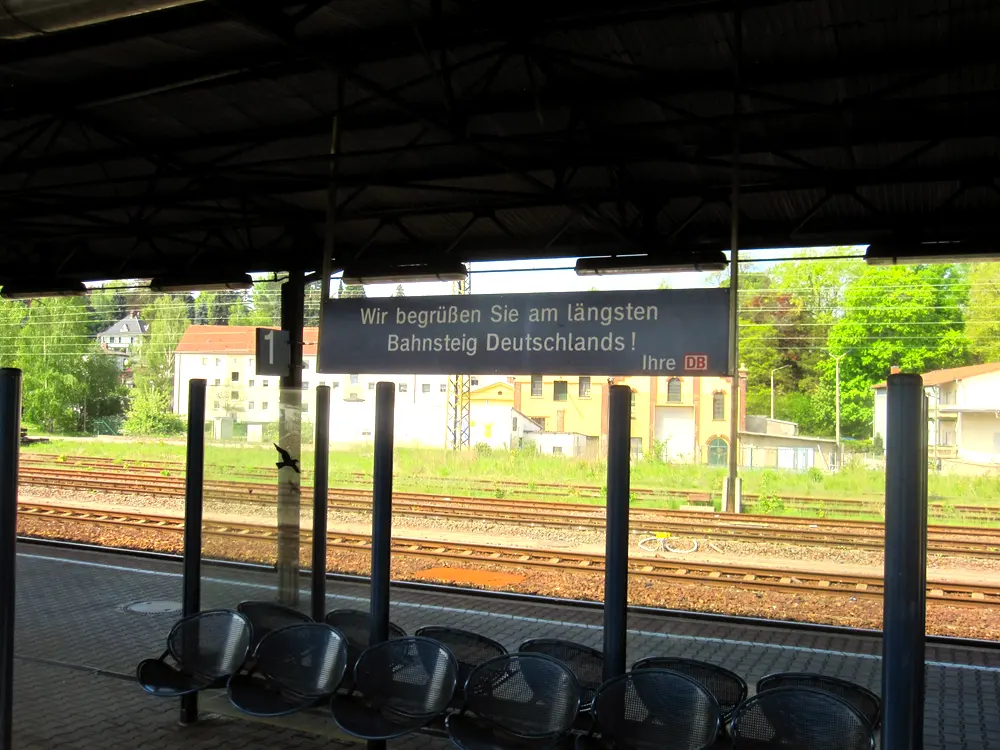
Whoever buys a Fahrkarte at the station, waits on the Bahnsteig, boards the Abteil and during the journey puts a letter in an Umschlag speaks a language that did not exist before 1890. All four words are inventions, and inventions with intent: they were to replace Billett, Perron, Coupé and Couvert, the words with which the railway and the post had come from France to Germany in the 19th century. That today they sound as natural as if they had always existed is the greatest success of a movement otherwise known mainly for its failures: German language purism.
Its history begins in the 17th century, when French was the language of the courts and a German nobleman was ashamed to write German. Philipp von Zesen, a poet from Anhalt, born in 1619, who spent most of his life in Hamburg and Amsterdam, resolved to cleanse German of everything foreign and invented hundreds of words for it. Many were so absurd that people still make fun of him today: Tageleuchter (day-lighter) for window, Zitterweh (shiver-ache) for fever, Jungfernzwinger (maiden-pen) for convent, Meuchelpuffer (murder-puffer) for pistol. But Zesen, whom the mockers of his time derided as a corrupter of language, also left us words we could not do without: Anschrift for Adresse, Bücherei for Bibliothek, Augenblick for Moment, Rechtschreibung for Orthographie, Verfasser for Autor, Leidenschaft for Passion. Nobody who says Augenblick today thinks of a man from Anhalt with a mission. That is the sign of a successful word.
A hundred and fifty years later Joachim Heinrich Campe, an educator from Braunschweig and tutor of the Humboldt brothers, turned the poet's whim into a system. His dictionary for explaining and Germanising the foreign expressions forced upon our language, published in 1801, contained about eleven thousand foreign words with proposed replacements, and Campe, credited with the zeal of an enlightener, pursued a political aim with it: a language the people understood was a precondition for the people having a say. Foreign words were for him class words with which scholars and officials set themselves apart from the others. Of Campe's eleven thousand proposals a few dozen caught on, among them Stelldichein for Rendezvous, Erdgeschoss for Parterre, Lehrgang for Kursus, Zerrbild for Karikatur, Esslust for Appetit, Feingefühl for Takt. Most of the others were forgotten at once. The two great poets in Weimar considered the man from Braunschweig a pedant and dedicated mocking verses to him.
The real breakthrough came not from poets but from an official. Heinrich von Stephan, Postmaster General of the new Reich, disliked in 1875 that his authority worked in a language its customers did not understand, and he ordered by decree the Germanisation of 760 expressions: Couvert became Umschlag, rekommandiert became eingeschrieben, poste restante became postlagernd, Billet became Postkarte, frankieren at first freimachen. What a poet did not achieve, a form achieved: whoever did not use the new words did not get their post. Ten years later, in 1885, Hermann Riegel, an art historian from Braunschweig, founded the General German Language Association, which within a few years had thirty thousand members and published Germanisation dictionaries for every sphere of life: for the kitchen, commerce, theatre, school, sport. To the association we owe Bahnsteig, Abteil and Fahrkarte, Bürgersteig for Trottoir, Rundfunk for Radio, Kraftwagen for Automobil, of which the first four won and the last two only half. Riegel himself, the founder, the association pushed out of the chairmanship in 1893 because he was not radical enough for it; he had understood the fight against foreign words as a question of taste, the association increasingly as a question of the nation. This path led where it led in Germany, and in 1940 Hitler himself banned further Germanisation because he preferred the foreign words of technology and the military to the coinages of his followers.
What does the balance sheet teach? First, that purism was wrong and right at once. Wrong, because foreign words do not corrupt a language but enrich it, as German had long proved with Fenster, Mauer, Ziegel, Keller, Küche and Wein from Latin by the time Zesen was born. Right, because an understandable word is better than an incomprehensible one and because Bahnsteig really does say something Perron does not. The words that stayed did not stay because an association decreed them but because they were shorter, clearer or more beautiful than what they replaced; Fernsprecher lost to Telefon because four syllables lose to three. And finally the balance sheet teaches something about the present. The same complaints made about French in the 19th century are made about English today, and from a distance they sound alike. Probably Download will never become Herunterlad, just as Telefon never became Fernsprecher. But perhaps someone will find a word that is better. Then in a hundred years nobody will know that someone invented it.