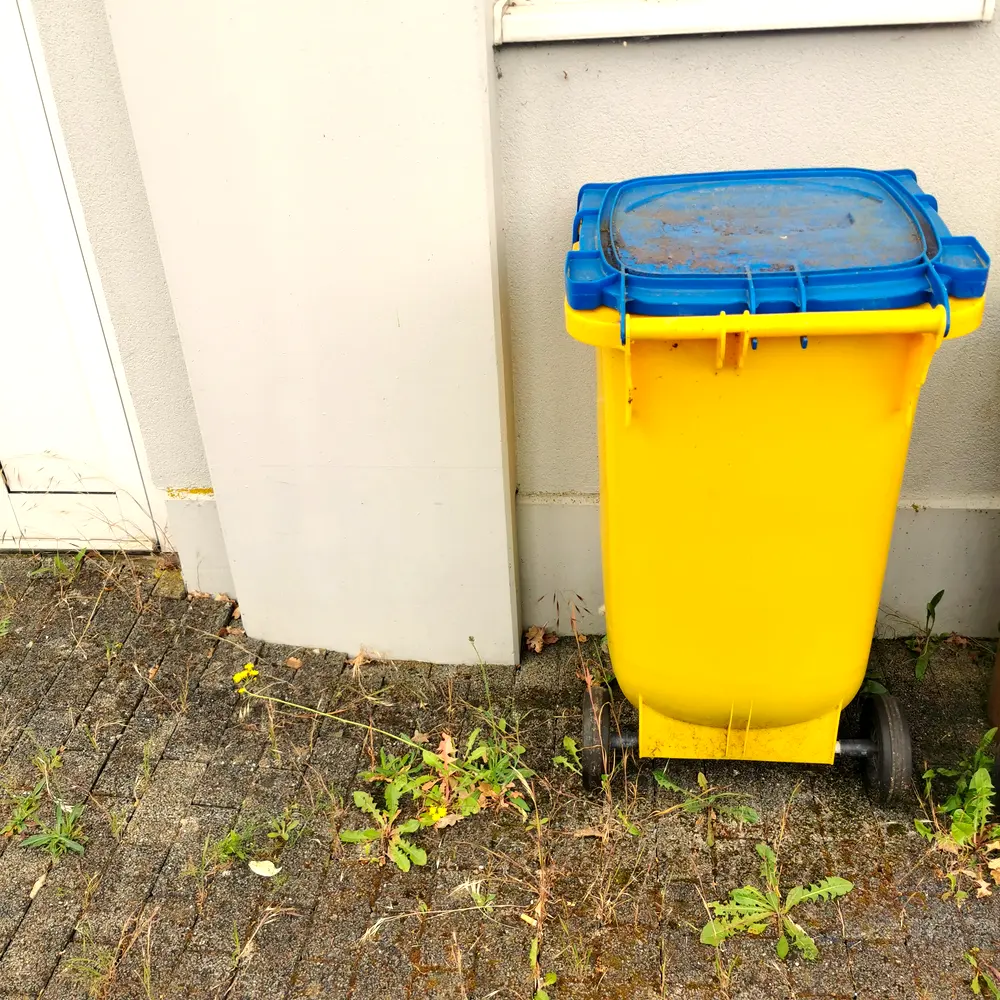
Whoever moves to Germany usually learns the first rule from a neighbour: the yoghurt pot does not go in the residual waste. In front of every house stand up to five bins, and their colours are almost the same everywhere: black or grey for residual waste, blue for paper, brown for organic waste, yellow for packaging of plastic and metal. Glass goes into containers on the street, separated into white, green and brown, and not after 8 pm, so that the neighbours can sleep. Added to that are deposit bottles you carry back to the supermarket, batteries that belong in the shop, and bulky waste that the city collects twice a year.
The system arose in 1991, when the landfills were full and the federal government passed a law: whoever makes packaging must see to it that it is taken back and recovered. Industry thereupon founded its own collection system and invented the Green Dot, a symbol that was soon stuck on almost every package. The manufacturers pay a fee so that their packaging is collected and recycled; the consumer pays it too, in that the products are a few cents dearer. Since 2019 a new packaging law sets the quotas: 63 per cent of plastic packaging must be recycled, 90 per cent of paper and glass.
The result shows in the statistics. Germany recycles around two thirds of its household waste and thus leads Europe. The landfills are closed; what is not recycled is burned, so that at least electricity and heat come from it.
Still there is criticism, and it comes from two sides. Environmental groups say that part of the yellow bag is not recycled at all but sold abroad or burned, because mixed plastic is hard to separate; the best packaging, they say, is the one you do not buy. And many citizens find the system too complicated: may the lid stay on the yoghurt? Does the pizza box go in the paper although it is greasy? The rules differ from city to city, so that even Germans have to look them up after moving.
Whoever separates wrongly risks little, but not nothing. The refuse collection leaves a wrongly filled bin standing, and in some cities the emptying then costs extra. The social price is dearer: the neighbour who sees the yoghurt pot in the wrong bin does not forget it.