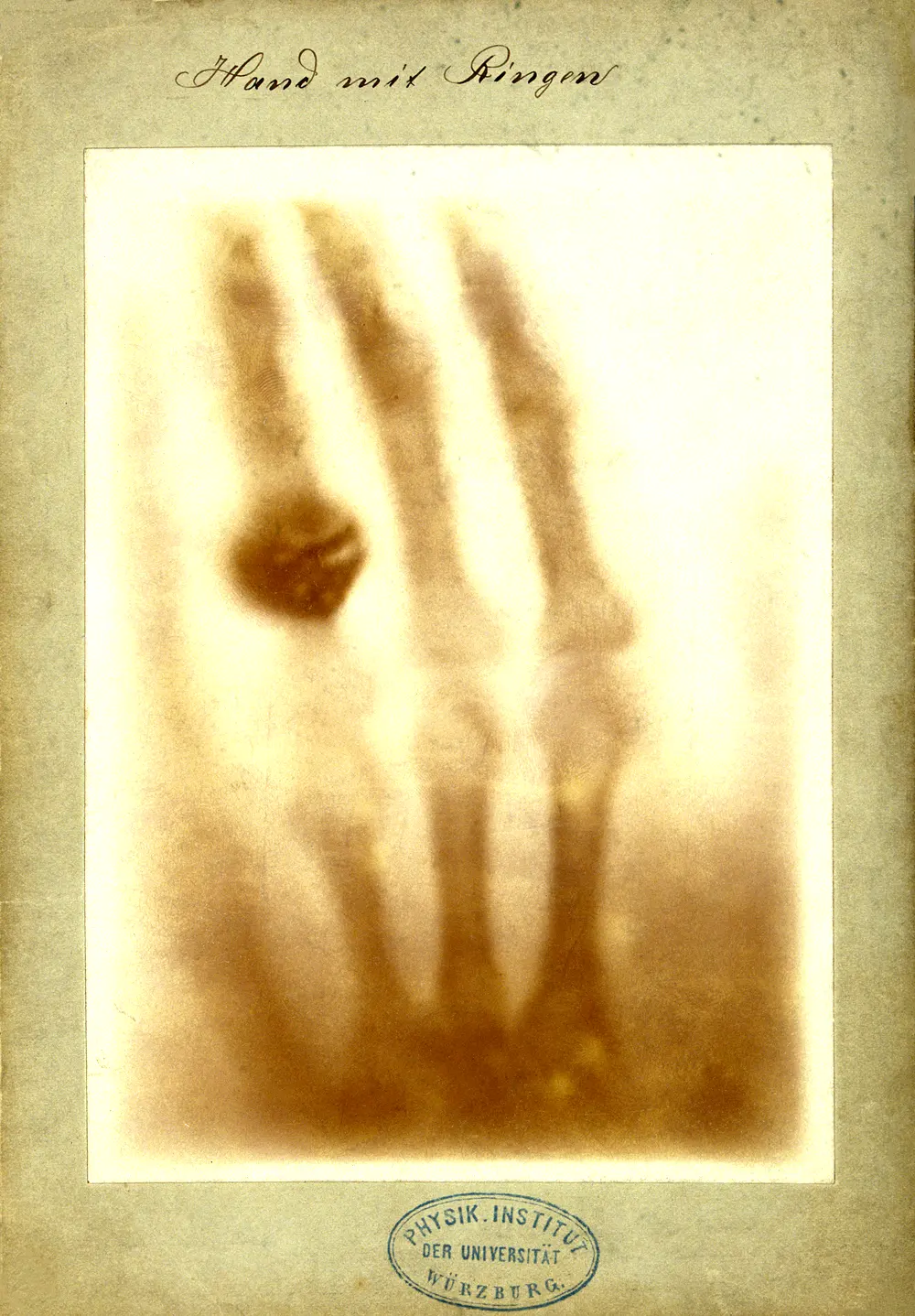
On the evening of 8 November 1895 the physicist Wilhelm Conrad Röntgen was working alone in his laboratory in Würzburg. He was experimenting with a glass tube through which he sent electric current, and had wrapped it in black cardboard so that no light escaped. Even so, he noticed a faint glow on a table nearby: a screen coated with a chemical substance was glowing, although no light could reach it. Something was passing through the cardboard. Röntgen called it X-rays because he did not know what it was, and spent the following weeks in the laboratory almost without a break. Shortly before Christmas his wife Anna Bertha laid her hand on a photographic plate. The picture of her bones with the wedding ring went around the world.
Had Röntgen gone home earlier that evening, someone else would have found the rays, perhaps years later. Had he filed a patent, he would have become a rich man. He declined: his discovery, he said, belonged to humanity. In 1901 he received the first Nobel Prize for physics; the prize money he gave to the university.
Thirty-three years later, in September 1928, the Scottish bacteriologist Alexander Fleming returned from holiday to his London laboratory. On the table still stood the dishes in which he had grown bacteria before leaving. One of them had gone mouldy. Anyone else would probably have thrown it in the bin. Fleming looked more closely and noticed that around the mould the bacteria had disappeared. The fungus was evidently secreting a substance that killed them. Fleming named it penicillin after the name of the fungus.
This story too has its 'had'. Had Fleming thrown the dish away, he would have noticed nothing. Had the summer's weather been different, the fungus might not have grown. And had a colleague on the floor below not happened to be working with moulds whose spores drifted up the stairwell, the contamination might never have occurred.
The world reacted to the two discoveries completely differently. Röntgen's rays were in use in hospitals within a few months; as early as spring 1896 doctors were using them to look for broken bones and swallowed needles, long before anyone suspected how dangerous too much of it is. Fleming's penicillin, by contrast, remained for over a decade a note in a journal that hardly anyone read.
And yet the word chance falls short. Röntgen could have taken the glow for an error and switched off; instead he asked the right question. Fleming had already discovered a bacteria-killing substance years before, in his own nasal mucus, and therefore knew what he was looking for. Both had prepared themselves for their accident. The French researcher Louis Pasteur had put it this way decades earlier: chance favours only the prepared mind.
The story has a sequel that is often forgotten. Fleming did not succeed in producing the active substance in pure form, and after a few years he almost gave the subject up. Only in 1940 did two researchers in Oxford, Howard Florey and Ernst Chain, take the work up again and turn the observation into a medicine that saved hundreds of thousands in the Second World War. In 1945 all three received the Nobel Prize. Without Florey and Chain, penicillin might have remained a footnote. A discovery, it turns out, is rarely a moment. Usually it is a chain of people who do not look away.