Vorlesung: Was wir über Gutenberg wissen
Press play and listen as many times as you like — the transcript appears once you check your answers.
C1.1 · 8 of 42
Lesson · 2 rules · you practise after the first one
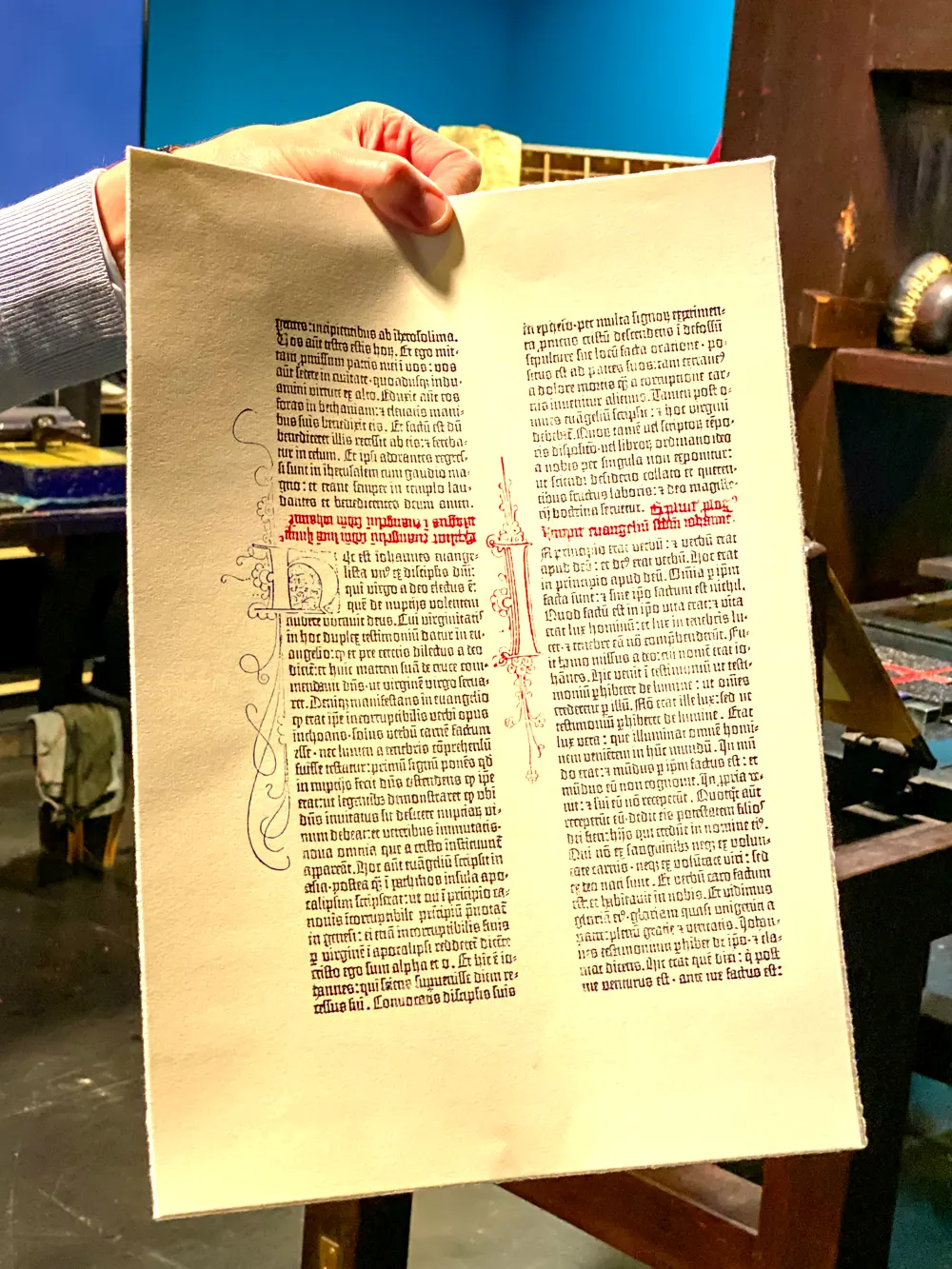
Ein Ausschnitt von etwa vier Minuten aus einer erfundenen Vorlesung zur Mediengeschichte über die am besten belegte und zugleich am häufigsten falsch erzählte Erfindung der Neuzeit: den Buchdruck mit beweglichen Lettern. Die Dozentin erzählt, was man über Johannes Gutenberg weiß und was nicht, wie die 42-zeilige Bibel entstand, warum ihr Drucker am Ende vor Gericht stand und was die Erfindung in fünfzig Jahren verändert hat. Sprachlich ist der Vortrag ein Lehrstück für die Tempuswahl, die du gerade geübt hast: Das Präteritum erzählt die Geschichte (Gutenberg lieh sich 800 Gulden), das Plusquamperfekt holt Vorzeitiges nach (nachdem er die Werkstatt eingerichtet hatte), das Perfekt bilanziert aus der Gegenwart (Die Forschung hat inzwischen gezeigt), das Präsens hält Gültiges fest (Etwa 49 Exemplare sind erhalten). Dazu kommen die Funktionsverbgefüge der Fachsprache: zur Anwendung kommen, in Betracht ziehen, zum Abschluss bringen, Anklage erheben, in Verzug geraten. Höre darauf, welche Zeitform die Dozentin wählt, wenn sie von der Wirkung auf die Gegenwart spricht.
Press play and listen as many times as you like — the transcript appears once you check your answers.
Lecturer: Good morning. Today we begin with the invention from which everything in this seminar proceeds, and I would like to start with a confession: about the man who made it we know astonishingly little. Johannes Gensfleisch, called Gutenberg, was born around 1400 in Mainz; the exact year we do not know. We possess no portrait of him, no letter in his handwriting and not a single printed work bearing his name. Everything we know comes from court records, tax lists and promissory notes. Gutenberg is in this respect a typical case: the sources are silent about success and talk about disputes. Lecturer: In order. In the 1430s Gutenberg lived in Strasbourg, where he worked with partners on an enterprise that the records call only 'art and adventure'; presumably it was already about printing. Around 1448 he returned to Mainz. After he had set up a workshop there, he borrowed 800 guilders from the merchant Johannes Fust, a sum for which one could buy several houses at the time, and a little later the same sum again. With this money, between about 1452 and 1455, the work arose that we today call the 42-line Bible, after the number of lines per column: two volumes, around 1,300 pages, in an edition of about 180 copies, of which around 30 were printed on parchment, the rest on paper. Lecturer: The actual invention was not the press; presses had existed for wine and paper for centuries. Nor was it the principle of movable characters, which had come into use earlier in Korea and China. Gutenberg's achievement lay in a system: a hand mould with which thousands of identical letters could be cast from a metal alloy, an oil-based ink that adhered to metal, and an organisation of labour that no longer copied a book but manufactured it. He thereby invented, if you like, not printing but the factory. Lecturer: And then the trial. In November 1455 Fust brought charges against Gutenberg because he had fallen behind with the repayment of the loans plus interest; over 2,000 guilders were at stake. The court essentially found for Fust. Gutenberg had to give up the workshop, or at least a large part of the equipment, and Fust continued the business with Gutenberg's former employee Peter Schöffer. The first dated and signed printed work in history, the Mainz Psalter of 1457, therefore bears the names Fust and Schöffer, not that of the inventor. Research has long argued over whether Fust was a swindler or a businessman who wanted his money back. The records allow both. Gutenberg died in 1468 in Mainz, not poor, as the legend says, but without his workshop. Lecturer: What followed went faster than anyone had considered. Fifty years after the Bible, printing shops were working in over 250 cities of Europe, and it is estimated that by 1500 around 30,000 different titles had been printed in several million copies altogether, more books than in the thousand years before. Luther would not have brought a Reformation to completion without this technique; his writings reached print runs within weeks for which scribes would have needed decades. Of the 42-line Bible itself 49 copies survive today, 21 of them complete, and it is considered the most valuable printed book in the world. Student: Excuse me, a question. If we know so little about him, how do we know it was Gutenberg at all and not Fust or Schöffer? Lecturer: Good question, and the answer is a demonstration of how historical scholarship works. First, the court record itself: it names the 'work of the books' as the purpose of the loans to Gutenberg. Second, a letter of 1455 in which a cardinal reports that he saw in Frankfurt quires of a printed Bible produced by an 'astonishing man'. And third, the statements of contemporaries who decades later still named Gutenberg as the first, among them Schöffer himself. No single piece of evidence suffices. Together they leave hardly any doubt. That, by the way, is also the method of this seminar.
Photo: dronepicr, CC BY 2.0, Wikimedia Commons
Exercise
Hören: Vorlesung über Gutenberg · C1.1
No single question is on screen — the report is about the whole exercise.
Reports go to the forum, where anyone can read them and the answer is kept for the next learner. To send one — and to be told when it is answered — sign in first. It takes one email, and no password.
Signing in lets us reply to your report, and shows you the answer the next time you are here. We email you a one-time link: no password, and nothing is shared with anyone.
Everything works without an account. Signing in backs your progress up, carries it to your phone, and lets you post on the forum.
One email, no password. We email you a one-time link: no password, and nothing is shared with anyone.