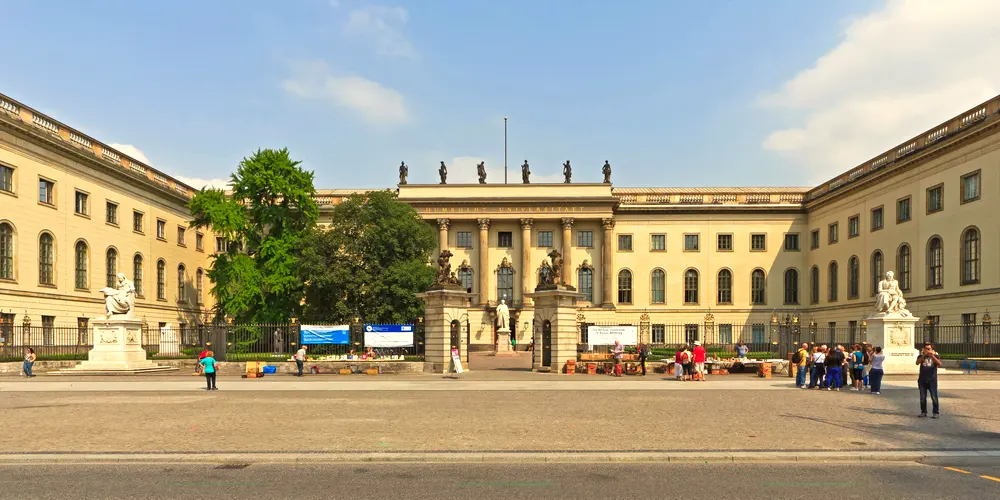
Anyone in Germany who opens a university, celebrates an anniversary or protests against a higher-education reform sooner or later invokes Wilhelm von Humboldt. Unity of research and teaching, education through scholarship, solitude and freedom: with these formulas the Prussian reformer counts as the inventor of the modern university, and the institution founded in Berlin in 1810, which today bears his name, as its mother. The formulas are so familiar that hardly anyone asks where they come from. The answer is more surprising than the legend.
First the facts. Humboldt headed the Section for Religion and Education in the Prussian Ministry of the Interior from February 1809 to June 1810, that is sixteen months. In view of the defeat by Napoleon, which had cost Prussia half its territory and the University of Halle, the state was, as the king put it, to replace through intellectual strength what it had lost in physical strength. Humboldt pushed through the founding of a university in Berlin, secured its funding and appointed the first professors. Then he handed in his resignation. When the first lectures began in October 1810 he was already envoy in Vienna. The university whose idea is attributed to him he never saw in operation.
The famous memorandum 'On the Internal and External Organisation of the Higher Scientific Institutions in Berlin', from which the formulas come, Humboldt wrote probably in 1809 or 1810. It remained a fragment, was never submitted and lay unnoticed in his papers for almost a century. Only in 1896 was it discovered, only in 1903 printed. Consequently nobody in the whole 19th century could appeal to it, and indeed nobody did. The professors who made Berlin great, Fichte, Schleiermacher, later Ranke and Helmholtz, spoke of scholarship, of the state, of freedom of teaching; the name Humboldt hardly came up in this connection.
The myth arose when it was needed. Around 1910, at the centenary of the Berlin university, the German university was in a crisis not unlike today's: student numbers had multiplied, the natural sciences demanded large laboratories and institutes, industry asked for applicable knowledge, and the state for control. Against all this the rediscovered memorandum could wonderfully be brought into position. Its author was an unsuspicious classic, its tone lofty, its demands so general that every party could appeal to it. Within a few years an unfinished administrative draft became the founding charter of the German university, and Humboldt its father.
Historiography has worked through this piece by piece since the eighties. It shows that the reforms attributed to Humboldt had largely been prepared in Halle and Göttingen, that the combination of research and teaching had long been practised there, and that the Berlin university in its first decades was anything but free of the state; on the part of the ministry, appointments and teaching content were decided as everywhere in Prussia. The historian Mitchell Ash coined the term for this that has governed the debate since: the Humboldt myth.
Admittedly it would be too simple to dismiss the myth as mere error. A myth that survives a century serves a function. The formula of the unity of research and teaching has in fact shaped how work is done at German universities: whoever teaches is to do research, and whoever does research is to teach. That distinguishes the system to this day from countries where research institutes and teaching institutions are separate. Regardless of its dubious origin, the myth has thus created a reality that authenticates it in retrospect.
Anyone who reads the memorandum today understands why it was suited to this. It is short, not twenty printed pages, and it does not argue, it proclaims. Scholarship is something not yet quite found and never quite to be found; the state should equip the university and otherwise keep out; teacher and student are both there for scholarship. Sentences of this kind can be put into any ceremonial speech because they hurt nobody. What the memorandum does not contain is equally revealing: not a word about examinations, degree programmes or vocational training, nothing about female students, who would not exist for another century, and nothing about money, except that the state should provide it.
Exactly therein lies its danger. Whoever invokes Humboldt does not argue but cites an authority, and one that can serve for almost anything: against tuition fees as well as for elite universities, against bachelor's programmes as well as for excellence initiatives. The memorandum is so indeterminate that it ennobles every purpose. In this respect the university would be better served if it justified its principles from the present rather than from a fragment its author did not even consider finished. Humboldt himself, who was a sober civil servant, would probably have been the first to insist on it.