Podiumsdiskussion: 25 Jahre Bologna
Press play and listen as many times as you like — the transcript appears once you check your answers.
C1.1 · 2 of 42
Lesson · 2 rules · you practise after the first one
Eine Podiumsdiskussion von etwa vier Minuten, erfunden, aber auf echten Zahlen gebaut: 1999 unterzeichneten 29 europäische Bildungsminister in Bologna die Erklärung, aus der Bachelor und Master hervorgingen. Ein Vierteljahrhundert später streiten eine Hochschulrektorin, ein Studierendenvertreter und ein Bildungsforscher darüber, was die Reform gebracht hat: vergleichbare Abschlüsse und weniger Abbrüche, sagen die einen; Verschulung, Prüfungsstress und weniger Auslandssemester, sagen die anderen. Der Text ist ein Übungsfeld für den Wortschatz, mit dem über Bildung und Wissenschaft gesprochen wird: der Abschluss, die Regelstudienzeit, der Leistungspunkt, die Anerkennung, die Abbruchquote, die Verschulung, die Durchlässigkeit, die Mobilität, berufsqualifizierend. Außerdem hörst du, wie Fachleute Zahlen in Beziehung setzen, mit den Konjunktionaladverbien, die du geübt hast: allerdings, gleichwohl, demnach, insofern, immerhin. Mehrere Fragen wollen wissen, wer welches Argument vertritt und worin sich die drei am Ende einig sind.
Press play and listen as many times as you like — the transcript appears once you check your answers.
Moderator: Good evening. In June 1999, 29 European education ministers signed a declaration in Bologna that was to standardise university study in Europe: tiered degrees, bachelor's and master's, credit points valid everywhere, and more mobility. A quarter of a century later we take stock. Professor Albrecht, you head a university. Was the reform worth it? Prof. Albrecht: On balance yes, even if I do not want to gloss over the early years. Bologna has achieved three things. First: degrees have become comparable. A bachelor's from Lisbon is understood in Leipzig, and vice versa. Second: after three years there is a first professionally qualifying degree. Whoever left after the basic studies before left with nothing; today he leaves with a certificate. Third: dropout rates have fallen. At universities about a third drop out of the bachelor's today; before the reform the rate was higher in many subjects, though we know the old figures only roughly. Mr Yilmaz: To sell a third of dropouts as a success I find bold. I represent the students, and what I see every day is something else: school-like rigidity. A bachelor's consists of modules, every module of an exam, and in the end you have written thirty, forty exams in six semesters. Study, which was once a free space, has become a timetable. You learn for the next test, not for the subject. And then mobility, Bologna's great promise: only about one in five bachelor's students goes abroad at all, because a semester away blows up the plan and the recognition of credit often does not work despite all the points. Dr Brandt: I would like to correct both pictures a little, because the data give a more mixed picture. The rigidity is real, but it is not a consequence of the Bologna declaration, which says nothing about modules or exam density. It is a German implementation. Other countries made the same reform with fewer exams. In that respect Mr Yilmaz is right, but with the wrong address. On mobility: a fifth sounds little, but it is more than before the reform, and in the master's almost half go abroad. That is something. What the data nevertheless show is a social imbalance: whoever goes abroad usually has parents who can pay for it. That was so before and has stayed so. Moderator: Professor Albrecht, the charge of exam density hits your university directly. Prof. Albrecht: And it is justified, I concede that. In the first years we attached an exam to every course because we believed the system demanded it. It did not. We have since cut the number of exams by about a third, and we are not finished. But I resist the notion that before Bologna everything was free space. Free space was for those who knew how to use it; the others got lost in it, and those were disproportionately the ones whose parents had not studied. Structure is also fairness. Mr Yilmaz: I do not disagree with that at all. I do not want a return to the Diplom. I want fewer exams, more freedom of choice within the structure, and semesters abroad not only for those whose parents can pay. Dr Brandt: So you are closer than it sounded earlier. If I may summarise: the architecture of Bologna, tiered degrees and comparable points, nobody questions any more. The dispute is about the German filling-in of this architecture, and that can be changed without sending a single minister to Bologna. Moderator: One sentence to finish from each of you. What should happen in the next 25 years? Prof. Albrecht: Examine less, supervise more. Mr Yilmaz: A semester abroad for everyone who wants one, regardless of the parents' wallet. Dr Brandt: Finally measure what the reform has achieved instead of arguing about it. We have been talking about Bologna for 25 years and have astonishingly little data.
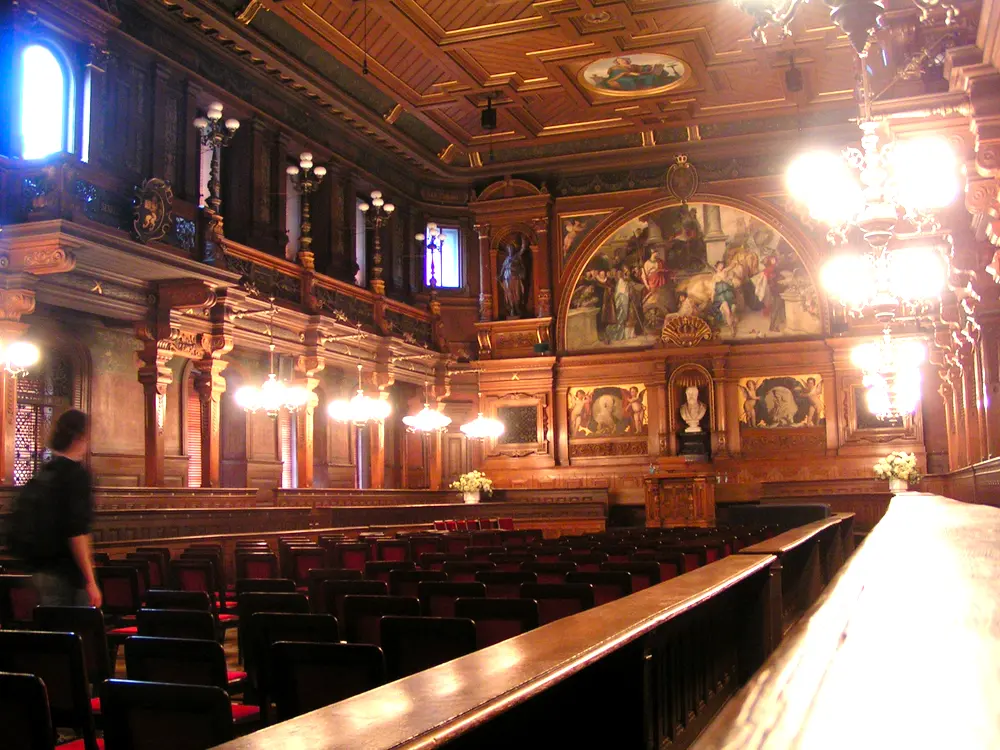
Photo: Stefan Kühn, CC BY-SA 3.0, Wikimedia Commons
Exercise
Hören: 25 Jahre Bachelor · C1.1
No single question is on screen — the report is about the whole exercise.
Reports go to the forum, where anyone can read them and the answer is kept for the next learner. To send one — and to be told when it is answered — sign in first. It takes one email, and no password.
Signing in lets us reply to your report, and shows you the answer the next time you are here. We email you a one-time link: no password, and nothing is shared with anyone.
Everything works without an account. Signing in backs your progress up, carries it to your phone, and lets you post on the forum.
One email, no password. We email you a one-time link: no password, and nothing is shared with anyone.