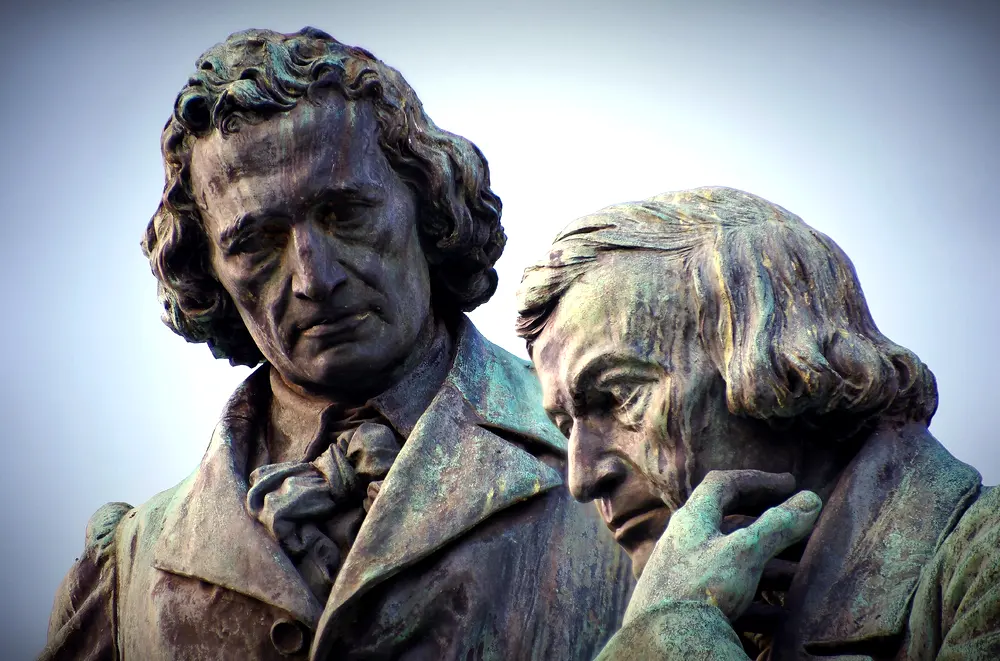
Hardly any German book has been translated into more languages than the Brothers Grimm's Children's and Household Tales, and hardly any carries a more stubborn legend with it. It goes roughly like this: two young scholars from Kassel, Jacob and Wilhelm Grimm, went round the Hessian villages at the beginning of the 19th century, sat down by the hearth with old peasant women and wrote down word for word what the people had been telling for centuries. The result, published in two volumes in 1812 and 1815, was said to be the unadulterated voice of the German people, rescued at the last moment from oblivion.
Almost nothing in this account is right, and the brothers themselves promoted it. In the preface to the second edition of 1819 they described their most important informant, Dorothea Viehmann, as a peasant woman from the village of Niederzwehren who recited her stories with the assurance of an ancient tradition. The description was right on one point: Viehmann lived in Niederzwehren. But she was not a peasant; she was the widow of a tailor and the daughter of an innkeeper at whose inn on the highway to Frankfurt carters and travellers from half of Europe put up. Her family, as research has shown since the seventies, descended from Huguenots, that is from French religious refugees who had come to Hesse in the 17th century.
The finding is even clearer for the other sources. Most tales of the first volume the Grimms owe not to the people but to a circle of young women from the Kassel middle class: the Wild sisters, daughters of a pharmacist, and the Hassenpflug sisters, whose mother came from a Huguenot family and in whose house French was still spoken. Some of what the Hassenpflugs told they knew from the tales of the Frenchman Charles Perrault, printed in Paris a hundred years earlier. Little Red Riding Hood, Sleeping Beauty, Puss in Boots: their German versions have a French family tree. Puss in Boots the Grimms therefore dropped again from the second edition, because the closeness to Perrault became too obvious to them; with the others they let it pass.
The second half of the legend, faithfulness to the spoken word, stands up to scrutiny just as little. Wilhelm Grimm, who largely looked after the collection alone after 1815, rewrote the texts unceasingly over four decades and seven editions. A comparison of the handwritten first draft of 1810 with the final edition of 1857 shows that terse, often brittle notes became fully worked-out narratives, with direct speech, recurring formulas and that tone which we today take for the fairy-tale tone as such. It is Wilhelm's invention. Added to this was the dispensing with everything that seemed indecent to a middle-class public: the natural mother who abandons Snow White became the stepmother; Rapunzel's pregnancy, which in the first edition betrays the prince's visits to the tower, became a harmless slip. What had begun as a collection for scholars thus became a household book for children.
Does that mean the brothers cheated? The question misunderstands what they were about. Jacob and Wilhelm Grimm were philologists at a time when the concept of the people was a political hope: while Napoleon's troops occupied fragmented Germany, people searched for what united Germans across all borders, and found it in language, law and poetry. The tales were to supply the proof that there was a common ground older than any state. A peasant woman by the hearth suited this hope better than a pharmacist's daughter with a French library. The Grimms did not lie; they saw what they expected to see.
That the brothers nevertheless became founders of a science is due to what they did besides the tales. Jacob wrote a grammar of the Germanic languages and described the sound shift that bears his name to this day; together the brothers began the German Dictionary in 1838, which had reached the letter D at Wilhelm's death in 1859 and the word Frucht at Jacob's death in 1863, and was completed only in 1961, after 123 years. Anyone who thinks the tales naive should look at this life's work: the Grimms were anything but dreamers. All the more remarkable that with the tales they saw what they wanted to see.
The disenchantment of the legend has not harmed the tales; on the contrary. On closer inspection it turns out to be the truly astonishing story: narrative material that had wandered between Italy, France and Germany for centuries was passed on in a small residence town by women whose families had themselves been wanderers, and shaped by a scholar into a language that now wanders on in 170 translations. The people whose voice the Grimms believed they heard never was one. It was Europe.