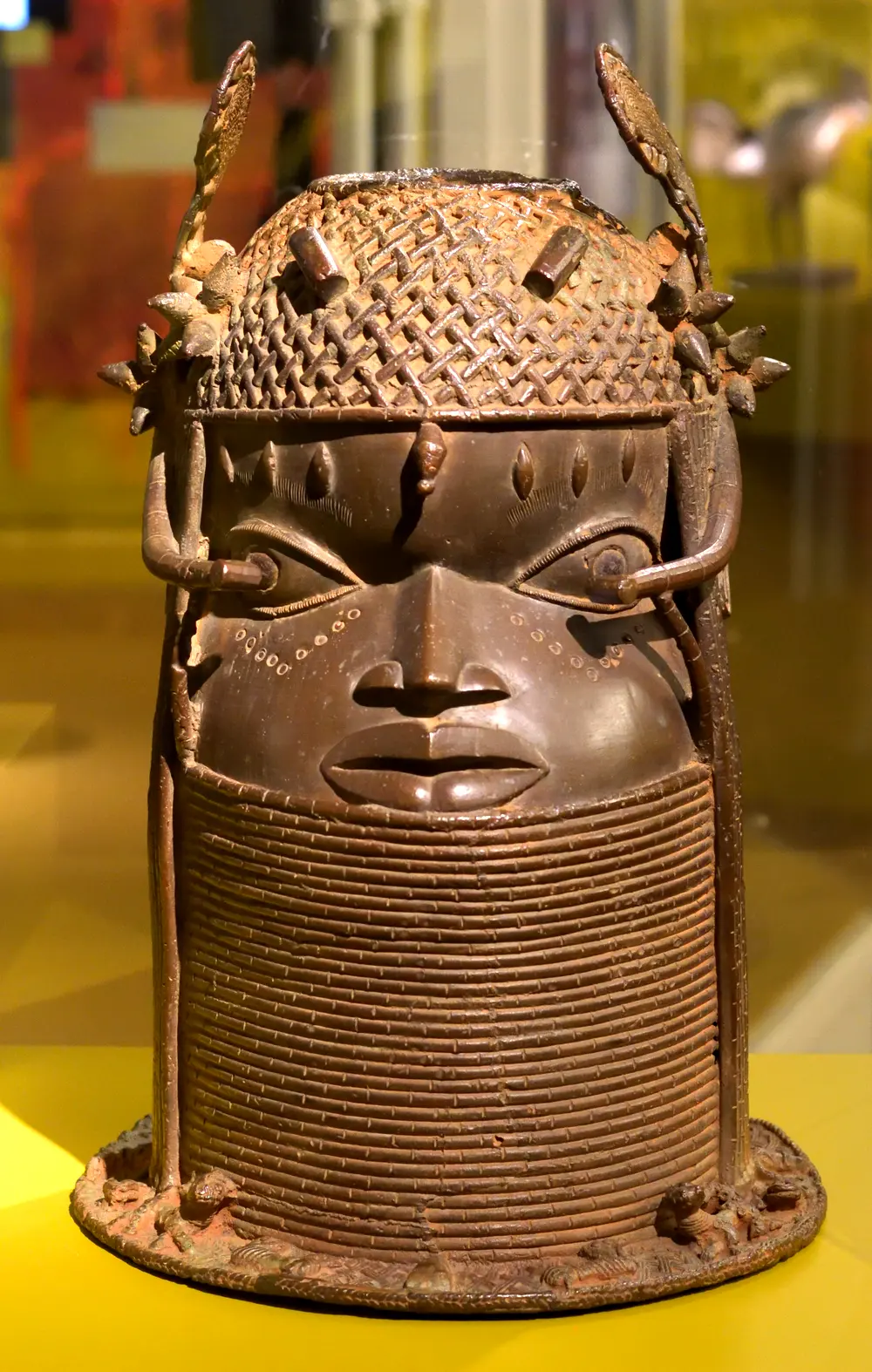
In February 1897 around 1,200 British soldiers marched into the city of Benin in present-day Nigeria, capital of a kingdom that had existed since the 13th century. Officially it was a punitive expedition: a few weeks earlier a British delegation on its way to the king, the Oba, had been attacked. The officers claim to have only secured the city; the records show that they burned down the palace, sent the Oba into exile and took along whatever could be carried. Several thousand objects, memorial heads of brass, relief plaques, ivory tusks, carvings, were shipped to London, where the War Office had them auctioned to cover the costs of the campaign. The pieces have been known since as the Benin Bronzes, although most are made of brass.
The buyers sat all over Europe, and strikingly many in Germany. Felix von Luschan, director of the African department of the Berlin ethnological museum, recognised earlier than the British what was being auctioned there, and bought on a large scale. He is said to have commissioned dealers to acquire every available piece in London before prices rose. As a result German museums soon owned the second-largest collection in the world: around 1,100 objects in about twenty institutions, over 500 of them in Berlin, more in Hamburg, Cologne, Stuttgart, Dresden and Leipzig. Luschan himself wrote that the art of Benin was in no way inferior to the European Renaissance, and that at a time when African art counted as primitive in Europe. That the pieces had been looted he knew; it did not trouble him.
What makes the pieces so significant only becomes clear when one knows what they were made for. The memorial heads stood on the altars of the palace, each for a deceased king, and the relief plaques, over nine hundred of them, had clad the pillars of the palace courtyard and told the history of the kingdom in pictures: its rulers, its wars, the first Portuguese who appeared on the coast in the 15th century. It was, in other words, the archive of a state that knew no writing. With the scattering of the pieces across the museums of the world this archive was torn apart.
Nigeria demanded the bronzes back from its independence in 1960, at first in vain. For decades the museums declared that the objects had been lawfully acquired on the open market and now belonged to the world's cultural heritage, which was in better hands in Europe than in Africa. Only when the debate about colonial loot gathered pace around 2017, in France through a report for the president, in Germany through the dispute over the Humboldt Forum, did this stance begin to waver. In 2021 the federal government, the states and the museums opened negotiations with Nigeria; in July 2022 the two foreign ministers signed a declaration, and in August the Prussian Cultural Heritage Foundation, as the first institution worldwide, transferred ownership of all its 512 Benin objects to Nigeria. About a third, so the agreement, would remain in Berlin on loan for ten years; the first twenty pieces were handed over in Abuja in December 2022. Cologne, Hamburg and Stuttgart followed.
The restitution was seen as a model, and it had hardly been carried out when the dispute began anew. In March 2023 the outgoing Nigerian president decreed that the owner of all returned bronzes was the Oba of Benin, Ewuare II, as successor of the king from whom they had been looted. For the descendants that was only consistent: the pieces had never been state art, they said, but part of the palace cult, which is kept up to this day. In Germany, by contrast, some felt deceived. One had returned them to the state, it was said, not to a monarch, and the planned museum in Benin City, in which the pieces were to be shown publicly, was now in question. An ethnologist called the agreement carelessly drafted because it had left the question of the owner to Nigeria. The Oba is said to be planning a palace museum of his own by now; when it opens is open.
Who is right? The federal government answered briefly: what Nigeria did with its property was Nigeria's business. The sentence sounds evasive but hits the point. A restitution made conditional on the recipient doing with what is returned what the giver considers right is not a restitution but a loan with conditions, that is exactly the relationship that was to be ended. That the debate about where the bronzes will stand in future is now conducted in Nigeria and not in Berlin is not a failure of the restitution. It is its proof.