The chair you are sitting on, the lamp above your table, the typeface on the sign outside your window: with some probability they go back to a school that existed for only fourteen years, was driven out three times and never had more than two hundred students at once. The Bauhaus, founded in Weimar in 1919, fled to Dessau in 1925, closed in Berlin in 1933, has become the most influential art school of the 20th century, and less in spite of its history than because of it.
The idea with which the architect Walter Gropius opened the school sounded backward-looking at first. Art and craft, so his founding manifesto, were to come together again as in the building lodges of the Middle Ages, in which stonemasons, glaziers and painters worked together on a cathedral. Hence the name. Every student first went through a preliminary course in which he experimented with materials, colours and forms, and then entered a workshop: joinery, metal, weaving, pottery, printing, stage. Teaching was done by two teachers at once, a master craftsman and an artist, and among the artists were Paul Klee, Wassily Kandinsky, Lyonel Feininger and Oskar Schlemmer, whose names hang in every museum today.
Weimar, which had inherited the school from the remains of two predecessor institutes, did not know what to do with it. The students wore smocks and home-sewn clothes, held loud parties and came from thirty countries; the city of the classics found that offensive. When a right-wing coalition won the state election in 1924, it halved the budget, and Gropius dissolved the school before it was taken from him. In hindsight Weimar should have kept its most famous institution; it has never quite got over the loss.
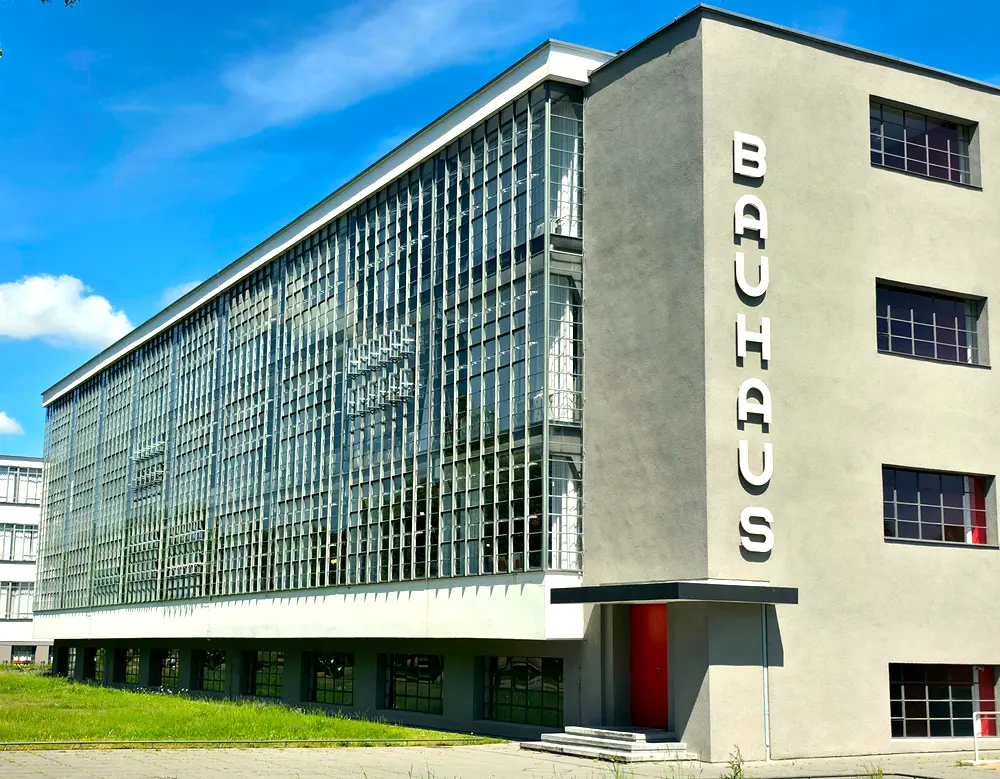
Dessau, by contrast, an industrial town with a Social Democrat mayor and an aircraft factory, courted the school and got it. There, in 1926, the building arose that shapes its image to this day: a complex of glass, steel and concrete whose workshop wing has a facade entirely of windows, with a bridge over the street, flat roofs and rooms in which the students lived, worked, ate and danced. Here the craft school became a factory for prototypes. Marcel Breuer, whose tubular steel chair made from bent bicycle tubing is still produced today, was head of the furniture workshop at 23. Marianne Brandt designed teapots and lamps, some of which have been on sale unchanged for ninety years.
That the school could exist at all, however, it owed to a workshop that usually gets short shrift in the legend: the weaving workshop. Gropius had admitted women but then steered almost all of them into the textile class, which was considered feminine. There, under the direction of Gunta Stölzl, the school's only female master, fabrics, carpets and wall hangings were created that sold like nothing else. Without the weaving workshop's licences the Bauhaus would have been bankrupt already in Weimar. The men designed the chairs, the women paid for them.
The Bauhaus was more than its teaching. Next to the school building Gropius had houses built for the masters, white cubes with big windows in which Klee and Kandinsky lived wall to wall, and on the edge of town an estate of over three hundred terraced houses for workers that was to show that good housing could be cheap. The school's parties, to which the students came in home-made costumes of wire and paper, were notorious all over Dessau. And the Bauhaus band played what was otherwise hardly heard in Germany: jazz.
The end came in stages. In 1928 Gropius left; he was followed by the Swiss Hannes Meyer, a convinced Marxist who demanded the people's needs instead of luxury needs and was dismissed in 1930 because he was too political for the town. His successor Ludwig Mies van der Rohe depoliticised the school, which did not save it: in 1932 the NSDAP won the municipal election in Dessau and pushed through the closure. Mies moved with the remainder as a private institute into an empty Berlin telephone factory. In April 1933 the police searched the building and arrested thirty-two students; in July the faculty dissolved itself before it was forced to.
It has often been asked whether the Bauhaus could have survived had it been less political. The question fails to see that its opponents never fought it because of individual teachers but because of what it stood for: flat roofs, glass, international students, women in trousers. But the closure brought about the opposite of what was intended. The teachers and students, most of whom emigrated, carried the school to Chicago, Tel Aviv and Tokyo, where they went on teaching. What Dessau had housed for fourteen years thus became the style of the world. Had the Bauhaus been left alone, it might have remained a good provincial school.