Plädoyer der Verteidigung
Press play and listen as many times as you like — the transcript appears once you check your answers.
C2.1 · 8 of 38
Lesson · 2 rules · you practise after the first one
Ein Schlussvortrag von etwa vier Minuten aus einem Strafprozess: Eine Verteidigerin spricht zum Gericht, bevor das Urteil fällt. Angeklagt ist eine Buchhalterin, die in einem kleinen Betrieb über zwei Jahre 140.000 Euro von einem Firmenkonto auf ein anderes umgebucht hat, um Löhne auszuzahlen, als der Inhaber das Geld anderweitig ausgab. Die Staatsanwaltschaft nennt es Untreue; die Verteidigerin erzählt, was in dem Betrieb geschah, zerlegt die Anklage Satz für Satz und beantragt Freispruch. Der Fall und die Personen sind erfunden; Verfahren, Begriffe und Paragrafen entsprechen dem deutschen Strafrecht. Juristische Sprache ist Sprache der Valenz, und genau die hast du zuletzt geübt: Jedes Verb verlangt seine Ergänzung in einem bestimmten Kasus. jemanden einer Tat beschuldigen, bezichtigen, überführen (Genitiv); jemandem etwas vorwerfen, zur Last legen (Dativ + Akkusativ); jemanden wegen einer Sache anklagen, verurteilen; jemanden von einem Vorwurf freisprechen; sich einer Sache schuldig machen; einer Sache bedürfen. Dazu die Semantik der Präfixe, mit denen das Recht seine Verben baut: ver- (veruntreuen, verurteilen, verschweigen, verjähren), ent- (entlasten, entziehen, entlassen), be- (beschuldigen, belasten, bestreiten), er- (ermitteln, erwirken), zer- (zerlegen, zerpflücken). Die Fragen prüfen, wen die Verteidigerin wessen beschuldigt, wem sie was vorwirft und was sie beantragt.
Press play and listen as many times as you like — the transcript appears once you check your answers.
Defence lawyer: Your Honours, Madam Presiding Judge, Mr Prosecutor. The indictment accuses my client of breach of trust in 26 counts. It charges her with having, over two years, transferred 140,000 euros from the firm's business account to the payroll account and thereby having damaged her employer's assets. This morning the prosecution requested a prison sentence of one year and eight months. In the next few minutes I will set out to you why this request misses the point, and I will ask you to acquit my client. Defence lawyer: Let us begin with what is undisputed. Ms Berger made the transfers. She has never denied it, not to the police, not to the insolvency administrator, not here. She recorded every single transfer in the books, with date, amount and purpose: wages March, wages April, wages May. Whoever misappropriates conceals. Whoever conceals does not book with a stated purpose. My client did not even try to conceal, because, and this is the core of these proceedings, she did not believe she was doing anything wrong. She believed she was doing her job. Defence lawyer: What was her job? She had been for nineteen years the bookkeeper of a firm with 23 employees. She knew on which day the rent fell due, when social insurance had to be remitted and when the wages. And she knew from the spring of the year before last that the money for it was not enough. Not because the firm had no orders; the witnesses from the workforce confirmed to you that the workshop was fully booked. But because the owner, the witness Mr Kraus, withdrew sums from the business account that had nothing to do with the business: a vehicle, a holiday flat, the settlement of private debts. About that he kept silent here as far as he could, and the prosecution did not consider it worth mentioning. I mention it because it puts the case on its feet. My client did not put other people's money in her own pocket. She booked money meant for wages to where it was meant to go, before someone else spent it elsewhere. Defence lawyer: Now the prosecution says that does not matter. The bookkeeper acted on her own authority, without instruction, against the owner's recognisable will, and thereby violated her duty to look after the assets. That is not absurd legally, and I will not belittle it. But breach of trust presupposes two things: a breach of duty and a financial disadvantage. What disadvantage did the firm suffer? The wages were owed. Every euro my client transferred discharged a claim the firm had to meet in any case, with interest and late-payment surcharges had it not been met. The firm did not become a cent poorer; it paid debts it had. The witness Kraus may be annoyed that the money for the holiday flat was missing. A financial disadvantage to the company that is not. It is a disadvantage to him, and he is not the injured party here but the one against whom the insolvency administrator is now himself asserting claims. Defence lawyer: I must remind you of the testimony of the witness Demir, the foreman. The prosecution summoned him to incriminate my client. He exonerated her. He said he went to her in April with three colleagues and asked whether they could still feed their families. And she said: I'll take care of it. She took care of it. Twenty-two families received their money on time for two years, in a firm whose owner spent it on himself. If that is breach of trust, then my client is guilty of it. I submit it is the opposite. Defence lawyer: No conviction is needed here to do justice. Ms Berger has lost her job, her pension savings are stuck in a firm that no longer exists, and she has sat on this dock for fourteen months for something her colleagues call decency. I move that the accused be acquitted of the charge of breach of trust in all 26 counts and that the costs of the proceedings be borne by the treasury. Should the court nevertheless find a breach of duty, I move that no punishment be imposed. For punished she has been already. Thank you.
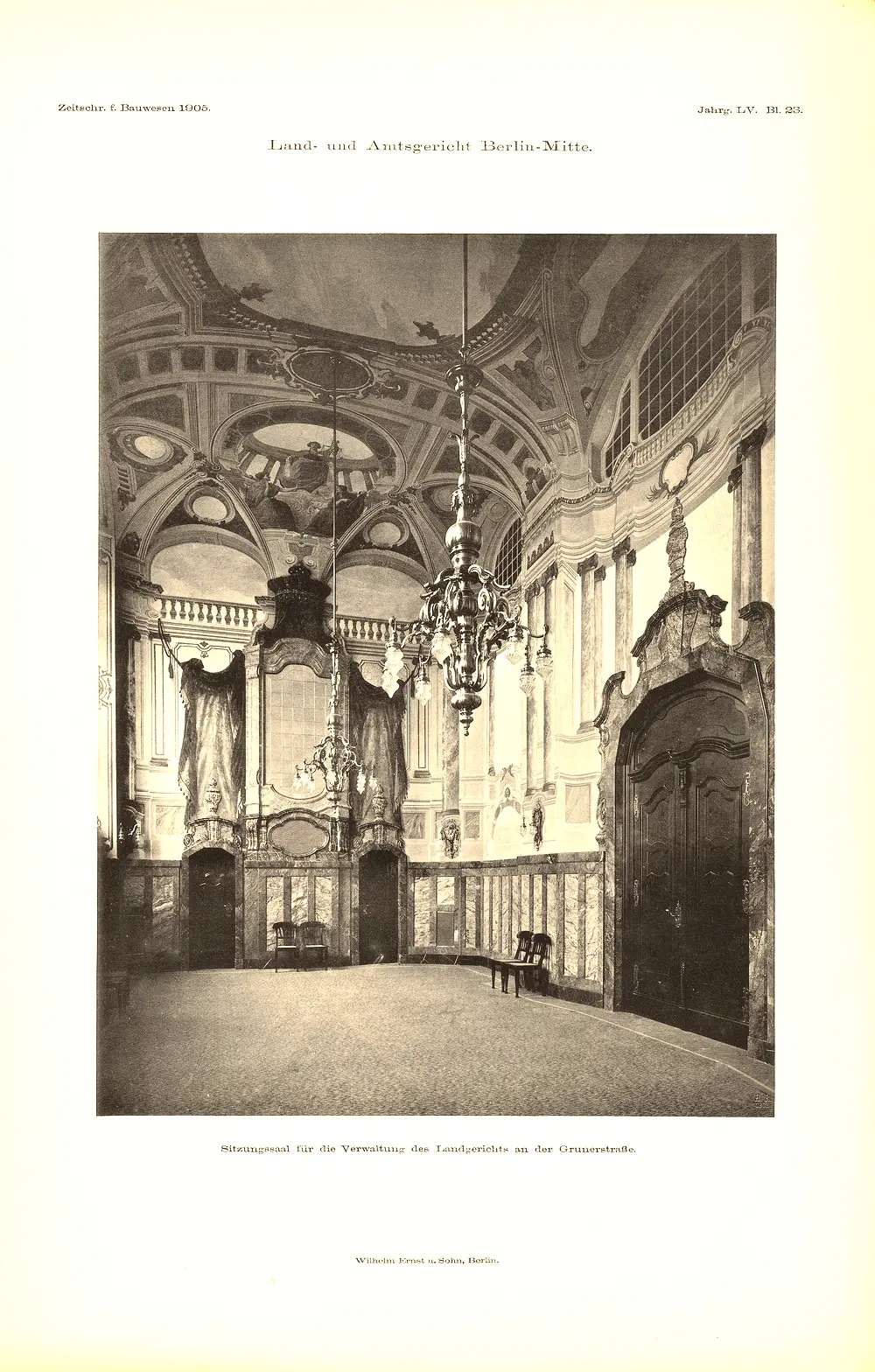
Photo: Otto Schmalz (1861-1906, als Architekt) Rudolf Mönnich (1854-1922, als Architekt) Hermann Rückwardt (1845-1919, als Fotograf), CC0, Wikimedia Commons
Exercise
Hören: Das Plädoyer · C2.1
No single question is on screen — the report is about the whole exercise.
Reports go to the forum, where anyone can read them and the answer is kept for the next learner. To send one — and to be told when it is answered — sign in first. It takes one email, and no password.
Signing in lets us reply to your report, and shows you the answer the next time you are here. We email you a one-time link: no password, and nothing is shared with anyone.
Everything works without an account. Signing in backs your progress up, carries it to your phone, and lets you post on the forum.
One email, no password. We email you a one-time link: no password, and nothing is shared with anyone.