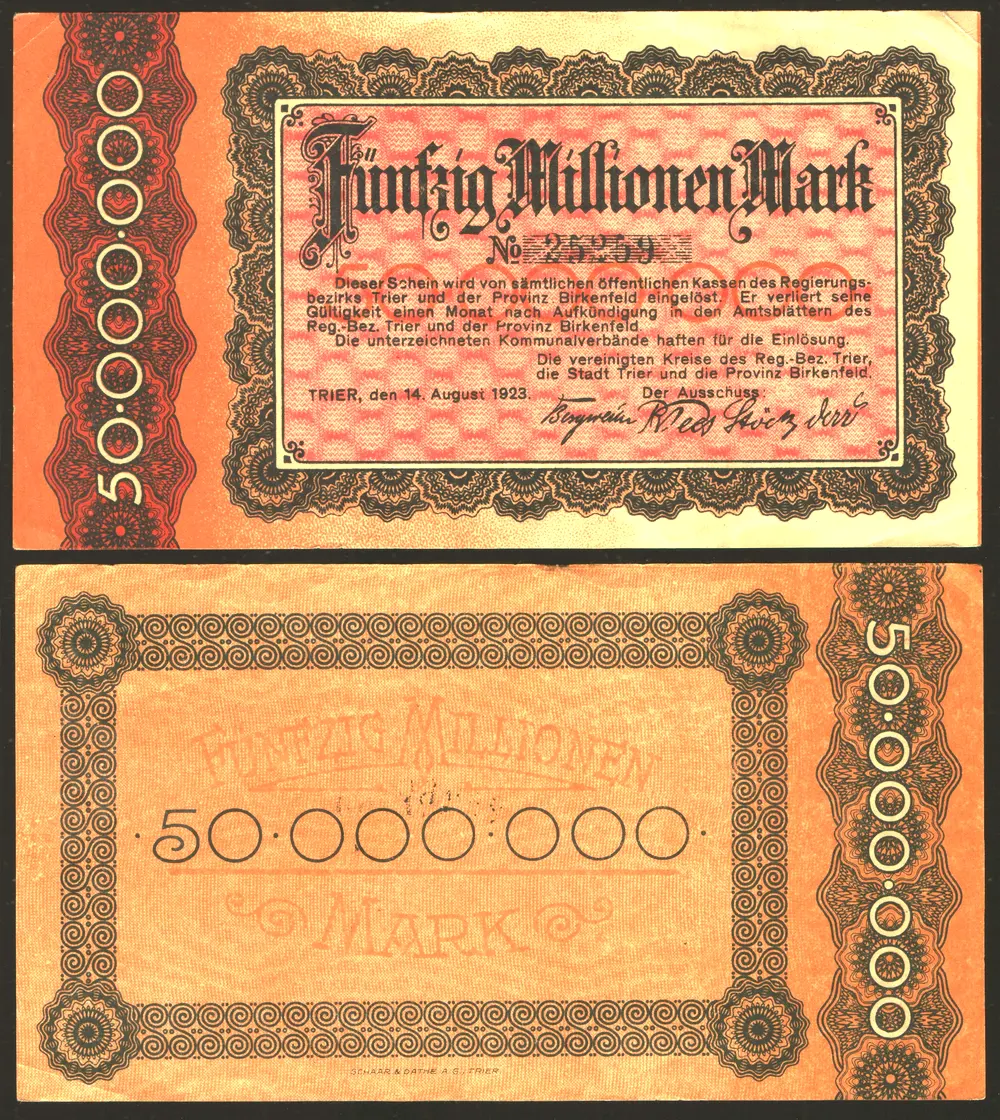
One can tell the German history of the year 1923 in a single column of figures. A kilo of bread cost 250 marks in January. In July it was 3,500, in September 1.5 million, in early October 14 million, in late October 5.6 billion. On 15 November, the day the nightmare ended, Berlin bakers asked 200 billion marks for a loaf, in some places more, and an American dollar cost 4.2 trillion marks on the Berlin exchange, a four with twelve zeros. Four years earlier it had cost 4.20 marks. The price had thus risen a trillionfold, a number for which everyday life offers no image and for which contemporaries found their own: children building towers with bundles of notes; housewives heating the stove with banknotes because notes were cheaper than wood; workers collecting their wages twice a day in laundry baskets and spending them in the lunch break because by evening they would be worth half.
How does a country get there? Not overnight, and that is the first error the story of 1923 suggests. The devaluation had begun in 1914, when the Empire financed the war not through taxes but through bonds and the printing press, in the expectation that the defeated enemy would pay the bill. The enemy did not pay; instead the Treaty of Versailles demanded reparations from Germany in an amount fixed in 1921 at 132 billion gold marks. The Republic, politically too weak to tax its citizens, kept printing. By 1922 the mark had fallen to a hundredth of its pre-war value, which was bad but not yet a collapse.
The collapse came with January 1923, when French and Belgian troops occupied the Ruhr to enforce outstanding deliveries of coal and timber. The Reich government called for passive resistance: miners, railwaymen and civil servants downed tools, and the state went on paying their wages, with money it did not have. From then on the printing press ran not to service debts but to feed an entire industrial region. Thirty paper mills and 130 printing works worked on behalf of the Reichsbank, and the more they printed, the faster each single note lost value. In the autumn notes of a hundred trillion marks were issued, printed on one side only because there was no time for the back.
Who lost is well known: everyone who owned money. Savers whose accounts had been filled over decades watched a life's work shrink to the price of a tram ride. Pensioners, widows, war invalids, civil servants, small landlords whose rents were capped by law: the middle class on which the young Republic should have rested. Less well known is who gained. Debtors paid off their mortgages with worthless money; industrialists who bought factories with borrowed billions owned the factories in the end while the billions had evaporated. Whoever had real assets, houses, machines, shares, foreign currency, came through; whoever had trusted the mark lost everything. That was the real lesson of 1923, and it was bitterer than the figures: not diligence and thrift had paid off, but debt and speculation.
The end was, compared with the road there, almost unspectacular. On 15 November 1923 a specially founded bank issued a new currency, the Rentenmark, backed not by gold, which the state did not possess, but by land charges on the entire soil and industry of the country, a security hardly anyone could have redeemed and which nevertheless sufficed. One Rentenmark was worth a trillion paper marks; the dollar stood at 4.20 Rentenmark, exactly as in 1914. What mattered was less the backing than the discipline that came with it: the government ended the Ruhr struggle, cut spending, dismissed civil servants and stopped printing. Within a few weeks prices were stable. The miracle of the Rentenmark, as it was called, was at heart a miracle of trust, restored as quickly as it had been destroyed.
But the consequences lasted longer than the crisis. The expropriated middle class did not forget who had expropriated it, namely the state, and when the world economic crisis came ten years later, its trust in the Republic was used up. Historians argue over how straight the line from 1923 to 1933 runs; that there is one, hardly anyone disputes. And a hundred years later Germans still think differently about money from their neighbours: they save more, they distrust debt, they pay cash, and they react to an inflation rate of three per cent as if it were three hundred. Economists consider that irrational, especially since Germans experienced a second currency reform in 1948 that followed not inflation but a war economy. But a trauma does not ask for statistics. It asks who paid the bill last time.