Gespräch: Warten auf das Verb
Press play and listen as many times as you like — the transcript appears once you check your answers.
C2.2 · 22 of 42
Lesson · 2 rules · you practise after the first one
Ein Radiogespräch von etwa vier Minuten mit einer Konferenzdolmetscherin, die seit achtzehn Jahren in den Kabinen des Europäischen Parlaments arbeitet. Sie erklärt, wie Dolmetschen zwischen 24 Amtssprachen überhaupt möglich ist, was eine Relaissprache ist, warum Deutsch für Dolmetscher die schwierigste Ausgangssprache Europas ist, nämlich wegen des Verbs am Satzende, mit welchen Tricks sie die Wartezeit überbrückt und was passiert, wenn ein Redner das Verb vergisst. Die Dolmetscherin ist eine erfundene Figur; Zahlen und Arbeitsweise entsprechen der Praxis der EU-Institutionen. Sprachlich geht es um zwei Dinge, die du zuletzt geübt hast. Erstens die Wortstellung und den Fokus: Was ans Ende rückt, trägt die Betonung, und wer das Verb erst am Schluss hört, muss den Satz im Kopf offenhalten: Ich habe den Vorschlag der Kommission trotz erheblicher Bedenken meiner Fraktion nach langer Beratung … abgelehnt. Zweitens das System der Modalverben, mit dem die Dolmetscherin Grade von Sicherheit und Verpflichtung beschreibt, auch die subjektiven: Der Redner muss das Verb vergessen haben; er dürfte zustimmen; er soll gesagt haben; er will nichts gewusst haben; das kann nicht sein; man mag es bedauern. Die Fragen prüfen beides.
Press play and listen as many times as you like — the transcript appears once you check your answers.
Presenter: Ms Lindqvist, for eighteen years you have sat in a glass booth above the plenary chamber of the European Parliament translating while people speak. The Union has 24 official languages. How can that work? Interpreter: Arithmetically, not at all. 24 languages make 552 directions, and for each you would need someone who commands both languages at the highest level. For Maltese into Estonian there is no such person. So we work with relay: the Maltese colleague interprets into English or French, and I take his English and bring it into German. The listener hears me with perhaps six seconds' delay, and hears two translations in a row without knowing it. Several hundred staff interpreters work in Parliament and many times that number of freelancers, and on a plenary day in Strasbourg about 800 of us are in the building. Presenter: You interpret into German. It is said German is the hardest source language in Europe for your profession. Is that true? Interpreter: Yes, and it is down to a single property: the verb comes last. A member says: I have the Commission's proposal despite serious concerns of my group and after long consultation with colleagues from the other committees … and now I have been talking into the microphone for twelve seconds, in English, I have, and I do not know whether he rejected, adopted, postponed or withdrew the proposal. In English or French the verb stands in second position, and everything else is decoration. In German everything else is the main clause, and the information stands right at the back. Mark Twain made fun of it as early as 1880; he wrote that a German speaker dives into a sentence as into an ocean and comes up on the other side of the Atlantic with the verb in his mouth. For us that is no joke, it is daily work. Presenter: And how do you bridge the time? Interpreter: With three tricks. The first is anticipation. I know the speaker, I know his group, I have the agenda, I hear his tone. Despite serious concerns and after long consultation: that sounds like someone who agrees and justifies himself for it. So I say: I have, after long consultations and despite serious concerns, decided to support, and in nine cases out of ten it is right. The second trick is rearrangement. I make two sentences out of his: the Commission made a proposal, there were concerns, long consultations, and the result is: pause until the verb comes. The third is the placeholder. I say something neutral, has taken a position on, and fill it in as soon as I know which. Presenter: And if the verb does not come? Interpreter: That happens. Not often, but it happens, and it happens above all with long sentences and free speech. The speaker has begun a qualification, then a second, then an insertion, and at the end he himself no longer knows how the sentence began and simply stops as if he were finished. If after thirty seconds no verb comes, he must have forgotten the beginning; then I finish the sentence the way he probably meant it, and he probably never notices. It is said to happen even to ministers, by the way. One is claimed to have once spoken a whole paragraph without a single finite verb; I was not in the booth, but the colleagues swear to it. Presenter: You speak in assumptions all the time. He must have forgotten, he probably does not notice, he is said to have said that. Interpreter: Because my profession consists of assumptions. I do not translate what someone said but what he is going to say, two seconds before he says it. I can be wrong, and then I correct myself in the next sentence, so quietly nobody hears. What I may not do is stay silent. A silent booth is a total failure for the listener. So I would rather say the probable than nothing, and German forces me to do it more often than any other language. Presenter: Have you ever asked a speaker to put the verb forward? Interpreter: Every German member, at least once. One may consider that impolite, but it helps. Some have done it for years and no longer know why. The others say: I have your request, Ms Lindqvist, despite full understanding for your situation and after careful consideration … And then they smile, and I wait.
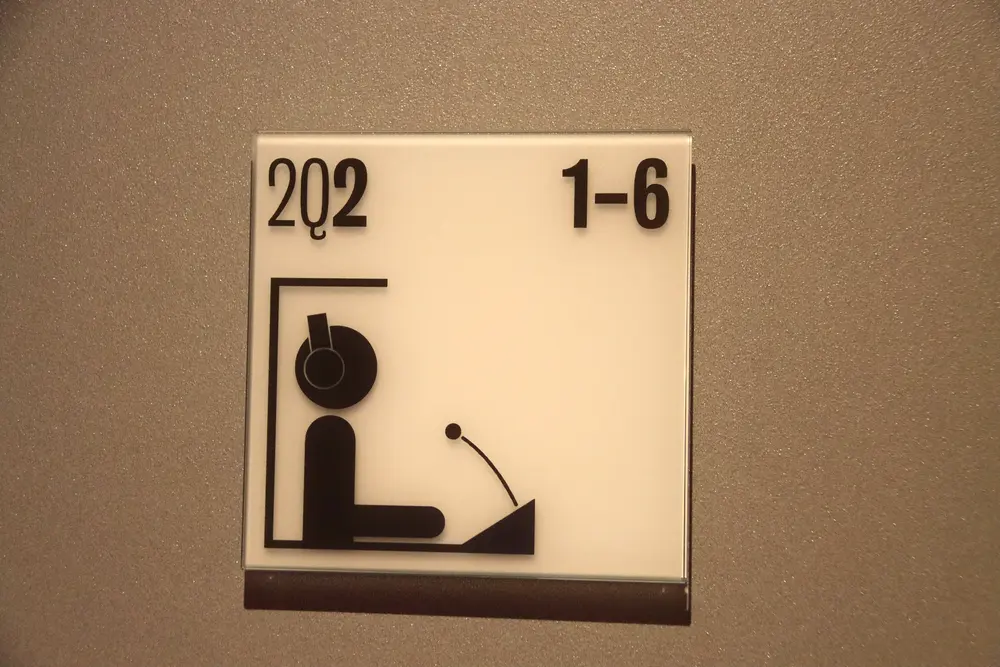
Photo: FrDr, CC BY-SA 4.0, Wikimedia Commons
Exercise
Hören: Warten auf das Verb · C2.2
No single question is on screen — the report is about the whole exercise.
Reports go to the forum, where anyone can read them and the answer is kept for the next learner. To send one — and to be told when it is answered — sign in first. It takes one email, and no password.
Signing in lets us reply to your report, and shows you the answer the next time you are here. We email you a one-time link: no password, and nothing is shared with anyone.
Everything works without an account. Signing in backs your progress up, carries it to your phone, and lets you post on the forum.
One email, no password. We email you a one-time link: no password, and nothing is shared with anyone.