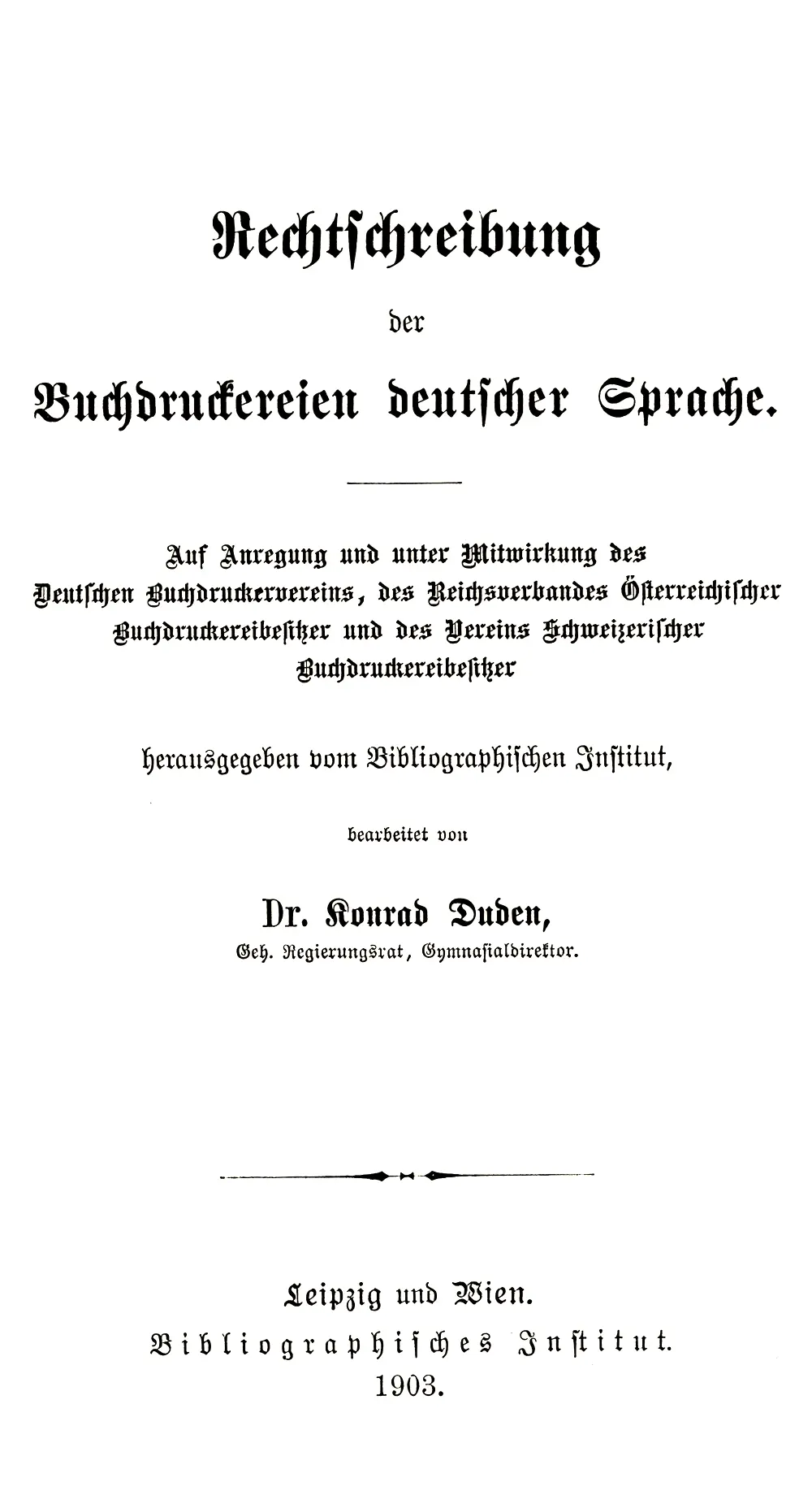
On 1 July 1996 representatives of Germany, Austria, Switzerland and some smaller states and regions signed in Vienna a declaration of intent on the reform of German spelling. The document was the result of almost ten years of commission work, and its ambition was modest: the rules of 1901, in force since the last orthographic conference in Berlin, were to be simplified, exceptions reduced and spelling made easier for pupils to learn. ß after a short vowel became ss, daß became dass, Schiffahrt became Schifffahrt with three f's, Känguruh became Känguru; some foreign words received Germanised variants such as Delfin and Portmonee, the comma rules were relaxed, and numerous combinations that had been written as one word for decades were now to be written apart: Rad fahren, kennen lernen, so genannt. None of it was revolutionary. The Intergovernmental Commission reckoned with a transition period of seven years and a change that would proceed as noiselessly as the introduction of postcodes.
What happened then can only be described as collective outrage. Within a few months more than a hundred writers, among them the country's best known, signed a declaration in Frankfurt demanding the reform be withdrawn; it was an intervention in the language by state bodies not authorised to make it. Parents sued in administrative courts against implementation at their children's schools, with varying success, until the Federal Constitutional Court ruled on 14 July 1998 that the education ministers, by virtue of their responsibility for schools, were entitled to regulate spelling there; no law was needed. Two months later the voters of Schleswig-Holstein voted in a referendum, by 56 per cent, to return to the old spelling, whereby the state kept the rules of 1901 for a year as the only one in the world, until the state parliament repealed the result for lack of alternatives. In August 2000 the Frankfurter Allgemeine Zeitung demonstratively returned to the old spelling; in August 2004 Der Spiegel and the Springer publishing house announced they would follow suit. Germany's most influential papers now wrote differently from Germany's schools.
Why? The reformers never quite understood, and that was part of the problem. They had taken spelling for a technical standard, comparable to a screw size one changes for the sake of uniformity when the old one has become impractical. The opponents took it for something else: a possession. Whoever had written daß for forty years owned that word, and the announcement that it was wrong from now on felt like the expropriation of a skill laboriously acquired at school that distinguished him from those who had not mastered it. Added to this, the reform made reading harder of all things in order to make writing easier: separations like wohl bekannt instead of wohlbekannt, viel versprechend instead of vielversprechend produced meanings nobody had intended. And finally there was something in the anger that went beyond language. The reform came from above, from a commission whose name nobody knew, decided by ministers nobody had elected for it, and it touched every individual in an area he considered his own. That the dispute flared up over one letter did not make it smaller, but easier to grasp.
The end was a compromise of the kind usual in this country. At the end of 2004 a Council for German Orthography convened, staffed with representatives of all states, of publishers, teachers, journalists and writers, and revised the reform in its most contested points: many compound spellings were allowed again, some commas returned, the foreign-word spellings were partly withdrawn. On 1 August 2006 the revised version came into force; the Frankfurter Allgemeine followed it a year later, and schools and newspapers wrote the same again, though no longer what had been decided in 1996, nor what had applied in 1901. ß after a short vowel remained abolished. Dass had won.
What remains, despite the calm, is a peculiar state. A whole generation writes less confidently today than its parents because at school it learnt rules that were partly withdrawn a few years later; the older ones in turn write a mixture of both, and the dictionaries list two variants for hundreds of words. The council continues to meet and changes things in small steps; in 2017, for instance, it added a capital ẞ to the alphabet that hardly anyone uses. One can read the story as a lesson in how a state loses a dispute it took for an administrative matter. One can also read it differently: a country that argues publicly for ten years over one letter takes its language seriously. There are worse qualities.