Gespräch: Die Richter in Rot
Press play and listen as many times as you like — the transcript appears once you check your answers.
C2.1 · 13 of 38
Lesson · 2 rules · you practise after the first one
Ein Radiogespräch von etwa vier Minuten über die Institution, der die Deutschen mehr vertrauen als jeder anderen: das Bundesverfassungsgericht in Karlsruhe. Eine Moderatorin fragt, ein Staatsrechtler antwortet: warum das Gericht 1951 nach Karlsruhe kam und nicht nach Bonn, wie seine sechzehn Richter gewählt werden, was eine Verfassungsbeschwerde ist und warum von fünftausend im Jahr nur ein paar Dutzend Erfolg haben, welche Urteile das Land verändert haben, vom Volkszählungsurteil bis zum Klimabeschluss, und ob ein Gericht, das Gesetze kippt, nicht zu mächtig ist. Sprachlich hörst du, was du zuletzt geübt hast. Erstens die Adjektivbildung, aus der die Rechtssprache ihre Genauigkeit zieht: verfassungswidrig und verfassungsgemäß, grundrechtsrelevant, unabhängig, unanfechtbar, zweidrittelmehrheitlich, höchstrichterlich, karlsruherisch (im Scherz), bindend, einstimmig, mehrheitsfähig. Zweitens Sprichwörter und feste Wendungen, mit denen der Gast seine Antworten zuspitzt: Wo kein Kläger, da kein Richter; Vor Gericht und auf hoher See ist man in Gottes Hand; Gleiches Recht für alle; Unrecht Gut gedeihet nicht; Wer die Macht hat, hat das Recht, und was er davon hält. Mehrere Fragen prüfen, ob du ein Sprichwort im Zusammenhang richtig deutest.
Press play and listen as many times as you like — the transcript appears once you check your answers.
Presenter: There is an institution in Germany that people trust more than the Bundestag, the government, the media and the churches combined: the Federal Constitutional Court. Around eighty per cent, year after year. Professor, where does this trust in sixteen people in red robes, whom hardly anyone knows by name, come from? Constitutional law professor: Partly precisely from the fact that one does not know them. The judges give no interviews on pending cases, they do not appear on talk shows, they decide and give reasons. And they sit in Karlsruhe, three hundred kilometres from Berlin, which is no coincidence. When the court was founded in 1951, it was deliberately not placed in the capital Bonn but spatially separated from government and parliament. Independence, that was the idea, should also be visible on the map. From that came the phrase politicians use with mixed feelings: Karlsruhe has decided. Presenter: How are the judges chosen? Professor: Half by the Bundestag and half by the Bundesrat, by two-thirds majority, for twelve years, without re-election, and they must stop at 68. The two-thirds majority is the decisive point: no party alone can push through a judge, so government and opposition agree on candidates both sides regard as independent and professionally beyond challenge. That is why the court never belonged to a political camp, unlike in the United States, where judges are pushed through for life by one party. However, one must say honestly: this system works only as long as two thirds of the members want to cooperate. If a party with more than a third of the seats blocks every election, the court stands still. That is why in 2024 the Bundestag wrote parts of the arrangement into the constitution so they cannot be changed by simple majority. Presenter: Most citizens encounter the court through the constitutional complaint. What exactly is that? Professor: Anyone who sees themselves violated by the state in a fundamental right can write to Karlsruhe, without a lawyer, without a fee, on a sheet of paper. Around five thousand people do so every year, prisoners, tenants, parents, companies, demonstrators. And about two per cent succeed. That sounds discouraging, but it matters, because among those two per cent are the cases that changed the country. No plaintiff, no judge: the court examines nothing on its own initiative. Every great ruling began with someone complaining. Presenter: Name us some. Professor: The census ruling of 1983. The government wanted to count all citizens and link their data; hundreds of thousands sued, and the court invented a fundamental right that is not in the text at all: informational self-determination, the right to know myself who knows what about me. All of European data protection grew out of that. Or the climate decision of 2021: young people sued, saying the climate law shifted the burdens into the future, and the court agreed. A law that does not do enough today violates the freedom of those who must live tomorrow. The Bundestag had to improve it. Or, quite differently, the decision that the state may not use stimulus loans to build a stockpile for other years; that plunged a government into crisis. Presenter: That brings us to the objection. Is a court that strikes down laws passed by an elected parliament not too powerful? Who votes the judges out? Professor: Nobody, and that is intentional. The 1949 constitution was written by people who had experienced how an elected majority abolishes democracy. Might makes right, that was the rule for twelve years. The court is the institution meant to refute that sentence every day: the majority too is bound by rules, and if it breaks them, someone who cannot be voted out tells it so. Of course that is an imposition on politics. But consider: the court has no money, no police, no soldiers. It has only its reasoning. If a government ignored a ruling, Karlsruhe could do nothing. That it has never happened in 75 years is due to exactly the trust you spoke of at the beginning. The court is as powerful as the citizens want it to be. Presenter: And how does one become a judge in Karlsruhe? Professor: By writing good judgments for forty years, being regarded as decent in both political camps and attracting nobody's attention. Before a court and on the high seas one is in God's hands, says the proverb. The same goes for the election of judges.
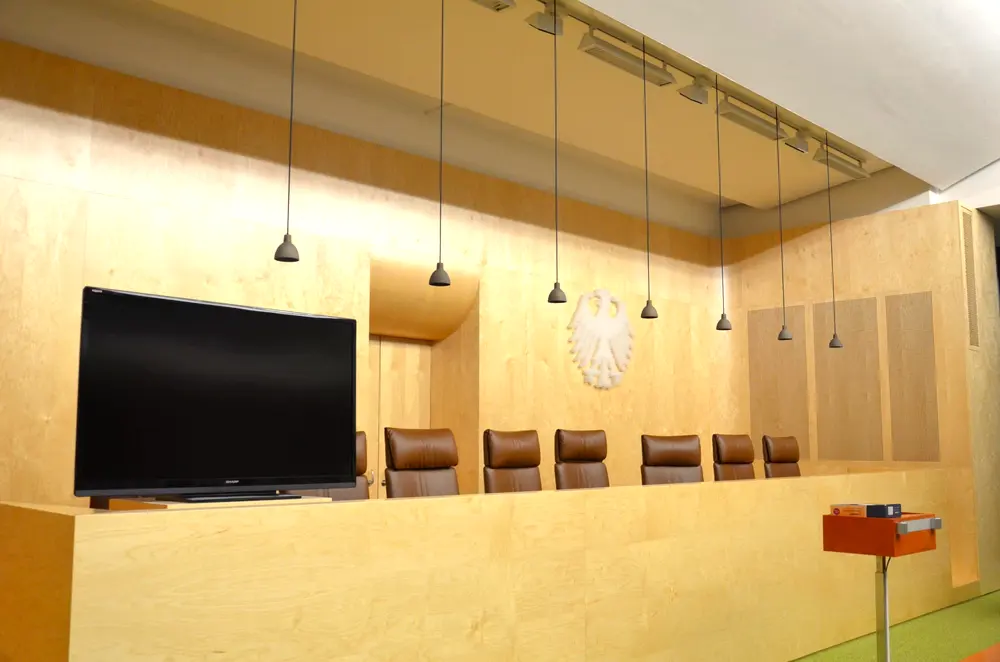
Photo: NatiSythen, CC BY-SA 3.0, Wikimedia Commons
Exercise
Hören: Die Richter in Rot · C2.1
No single question is on screen — the report is about the whole exercise.
Reports go to the forum, where anyone can read them and the answer is kept for the next learner. To send one — and to be told when it is answered — sign in first. It takes one email, and no password.
Signing in lets us reply to your report, and shows you the answer the next time you are here. We email you a one-time link: no password, and nothing is shared with anyone.
Everything works without an account. Signing in backs your progress up, carries it to your phone, and lets you post on the forum.
One email, no password. We email you a one-time link: no password, and nothing is shared with anyone.