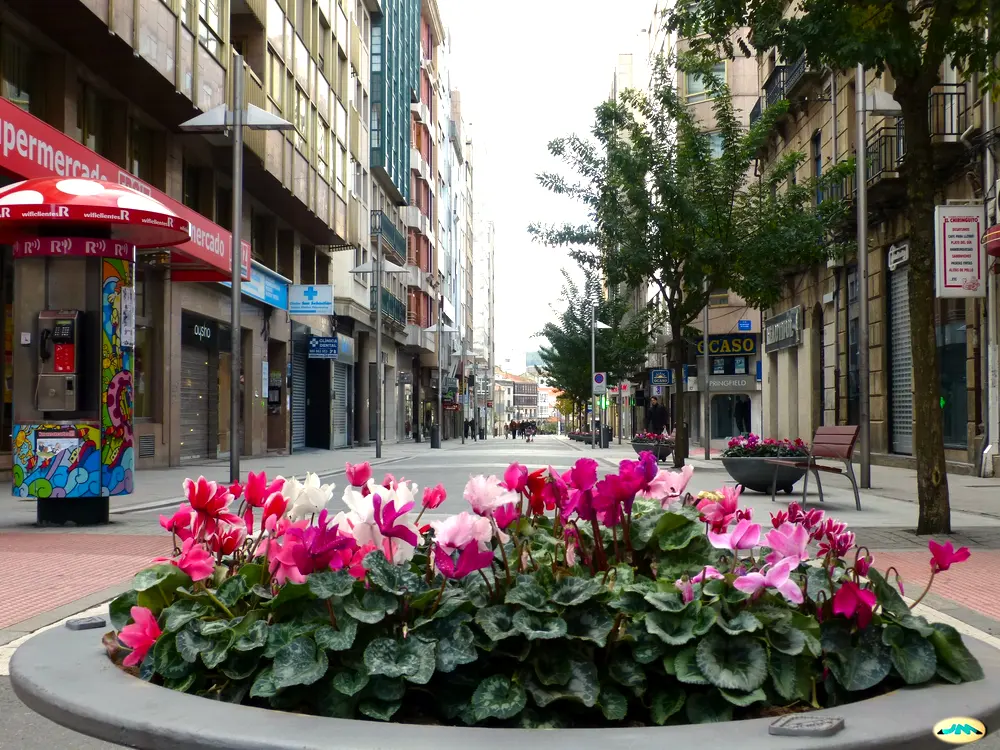
Car-free city centres are argued about in many countries, mostly with guesses: some expect a paradise, others the death of the retail trade. Yet there is a city where you can simply go and look. Pontevedra, a city of around 80,000 inhabitants in Galicia in north-west Spain, closed its centre to through traffic as early as 1999.
As late as the nineties the city was regarded as a problem case. Tens of thousands of cars pushed through the narrow streets of the old town every day, the squares were full of parked cars, the air was bad. Young families moved away, shops closed. When the doctor Miguel Anxo Fernández Lores became mayor in 1999, he acted quickly: within a month the entire historic centre was declared a pedestrian zone. Further districts were added later.
The car was never banned entirely, however. Residents may drive to their garages, delivery vans and emergency services still come in, if only slowly. What was abolished was something else: parking in the street and driving through. Anyone who used to drive straight across the centre to save time now has to go round the outside. Instead, more than a thousand free parking spaces were created on the edge of the centre, from which you can walk into the centre in a few minutes. In addition, the city had pavements widened, traffic lights removed and a map printed that gives distances not in kilometres but in minutes on foot.
The shopkeepers had protested fiercely at first, because they feared for their customers. The figures, however, tell a different story. According to the city, CO2 emissions in the centre have fallen by about two thirds. More than two thirds of all journeys are made on foot or by bike. In the traffic-calmed zones nobody has died in road traffic for more than a decade. And while many cities in the region are losing inhabitants, Pontevedra has grown; families with children above all have moved in. The mayor has been re-elected several times since.
As a result, urban planners from all over Europe travel there today to study the model. Whether it can be transferred is nevertheless disputed. Pontevedra is compact; almost everything is less than half an hour's walk apart. In a city of a million with long commutes the same plan would hardly be feasible, at least not without a dense network of buses and trains. There are also residents who are annoyed by longer detours in the car.
The change shows most clearly in the children. Many walk to school without their parents, which has become rare in most European cities. Shopkeepers and volunteers along the school routes make sure they arrive safely. Behind this is a simple idea in urban planning: a city in which an eight-year-old child can be out alone is also safe for an eighty-year-old woman, and so for everyone else as well. International organisations have given Pontevedra several awards for this.
Lores himself answers such objections with a question that has often been quoted since: who does public space actually belong to? It is not his job as mayor to find everyone a parking space, he says. After all, anyone who buys a cow or a fridge does not ask the city where to put them. You do not have to share this view. But the city shows that the question is worth asking.