Vortrag: Schlaf
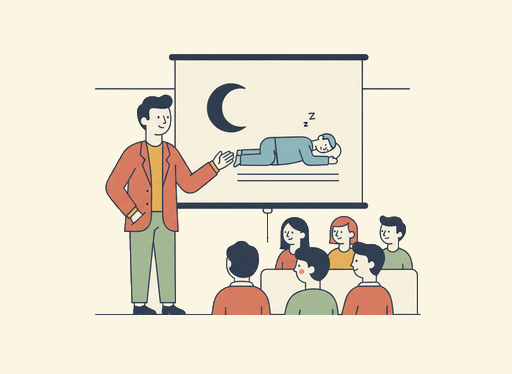
Press play and listen as many times as you like — the transcript appears once you check your answers.
B2.2 · 9 of 38
Lesson · 3 rules · about 3 min
Ein Vortrag über Schlaf, etwa 280 Wörter, einmal gehört. Er folgt der Reihenfolge fast jedes Vortrags: Begrüßung und Behauptung (Viele von uns schlafen zu wenig), Beleg (Studien zeigen, dass Erwachsene durchschnittlich sieben bis acht Stunden brauchen), Folge (Wer dauerhaft weniger schläft, riskiert gesundheitliche Probleme), ein zweiter Faktor (Neben der Dauer ist aber auch die Qualität des Schlafes entscheidend), eine Ursache (das blaue Licht der Bildschirme) und eine Empfehlung im Konjunktiv (Weniger Bildschirmzeit am Abend würde vielen Menschen besseren Schlaf bringen). So sind Vorträge, Podcasts und Radiobeiträge gebaut, und die Fragen folgen dem Vortrag der Reihe nach. Die Kunst ist, die Schritte des Vortrags zu erkennen. Dann kommen die Antworten dort, wo du sie erwartest. Zahlen (sechs, sieben bis acht) und einschränkende Wörter (nur zum Teil, eher kühl) sind die üblichen Fallen, und die Empfehlung ist fast immer die letzte Frage.
Press play and listen as many times as you like — the transcript appears once you check your answers.
Good evening and a warm welcome to my talk on sleep. I would like to start with a simple observation: many of us sleep too little. In a survey by our institute, almost one adult in three said they sleep less than six hours a night during the week. How much sleep do we actually need? Studies show that adults need seven to eight hours on average. Children and teenagers need considerably more, older people on the other hand often a little less. Anyone who permanently sleeps less risks health problems: the immune system becomes weaker, the risk of cardiovascular disease rises, and concentration suffers too. Many believe they could simply catch up on missing sleep at the weekend. That, however, only works in part. Besides the duration, though, the quality of sleep is decisive. Anyone who lies in bed for eight hours but keeps waking up is still not rested in the morning. Particularly important for deep sleep are a dark, rather cool bedroom and fixed times for going to bed and getting up – at the weekend too. A big problem today is the light from screens. Mobile phones, tablets and laptops emit blue light, which signals to the body that it is still daytime. That is why many people find it hard to fall asleep when they read messages or watch series until shortly before midnight. Coffee in the afternoon and heavy food late in the evening can also disturb sleep. Anyone who still wants to do sport in the evening should do so at the latest two hours before going to bed. So what can we do? My most important advice is simple: put your phone away an hour before going to bed. Less screen time in the evening would bring many people better sleep – and it costs nothing. Thank you for your attention.
Exercise
Hören: Ein Vortrag · B2.2
No single question is on screen — the report is about the whole exercise.
Reports go to the forum, where anyone can read them and the answer is kept for the next learner. To send one — and to be told when it is answered — sign in first. It takes one email, and no password.
Signing in lets us reply to your report, and shows you the answer the next time you are here. We email you a one-time link: no password, and nothing is shared with anyone.
Everything works without an account. Signing in backs your progress up, carries it to your phone, and lets you post on the forum.
One email, no password. We email you a one-time link: no password, and nothing is shared with anyone.