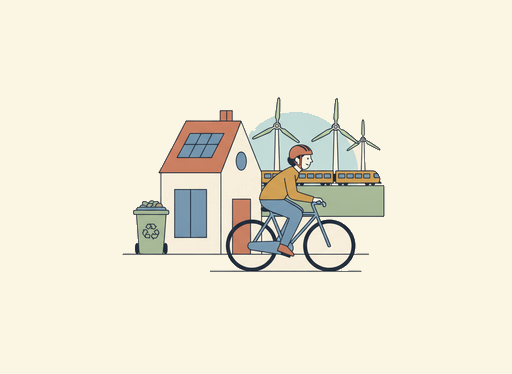
In the media, climate change is often presented as a problem that only politics could solve. Big decisions are indeed indispensable: without laws for industry, transport and energy supply, the climate targets will not be reached. Only the state can, for example, organise the expansion of railway lines and power grids on a large scale. But anyone who concludes from this that their own behaviour plays no role is making it too easy for themselves.
Around a quarter of greenhouse gases can be traced directly or indirectly to private households – to heating, car journeys, flights and what we eat and buy. Anyone who eats less meat, cycles more often and consumes more consciously therefore does contribute to climate protection. That does not mean everyone has to give up everything. Even small changes have an effect if many people make them.
There is also a second effect that is often overlooked: consumer behaviour changes the market. When more and more customers asked for green electricity, the energy suppliers expanded their range. The same applies to food: since more people have been eating vegetarian, almost all supermarkets have significantly expanded their range of meat substitutes. And where many people cycle, better cycle paths appear sooner or later. Private decisions are therefore political signals too.
Of course, responsibility must not simply be shifted onto the individual. Anyone who lives in the countryside with no bus at the door cannot easily do without a car. Here politics really is called upon.
One thing is clear, though: had everyone cut their energy consumption twenty years ago, the situation today would be less dramatic. That time cannot be brought back. But it is never too late to start.