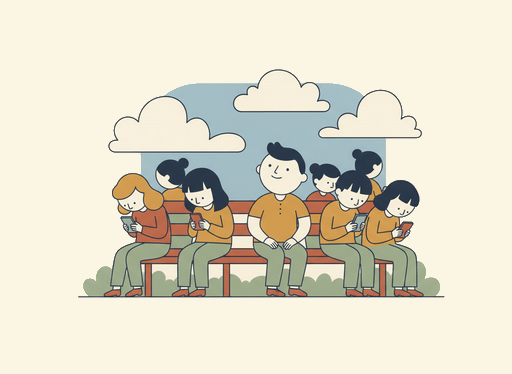
Boredom is regarded today as something to be avoided at all costs. No sooner does a free minute arise than we reach for the smartphone. At the bus stop, in the waiting room, in the queue at the checkout: nowhere does anyone have to endure any more that nothing happens. The devices in our pockets promise to fill every gap in the day, and we accept the promise gratefully. Parents buy their children tablets so that the car journey isn't boring; adults listen to podcasts while brushing their teeth. Anyone who says today that they were bored at the weekend is almost confessing a failure.
Yet it is often overlooked that boredom in particular fulfils an important function. It creates space for one's own thoughts and for creativity. Psychologists speak of the brain's "idling" – that state in which we apparently do nothing and in which nevertheless memories are sorted, problems turned over and plans forged. Most people know the experience that the solution to a problem occurs to them in the shower or on a walk, not at the desk. That is no coincidence. The idea needs the emptiness into which it can fall.
Anyone who is never bored gives their mind no opportunity to develop new ideas. They are constantly busy but rarely with themselves. Attention wanders from one message to the next without lingering anywhere; at the end of the day one has seen a thousand things and thought none. Children who bridge every waiting time with a screen do not learn to occupy themselves – a skill that is indispensable in adult life.
One will object that boredom can also be tormenting: the endless meeting, the empty afternoon hour in the old people's home. That is true, and nobody argues for abandoning people to dreariness. The difference lies between the boredom that is forced upon us and the boredom we allow ourselves. The first dulls; the second frees.
We flee from silence. And yet it is silence that lets us think. Perhaps it would be wise to understand boredom not as an enemy but as a source – and to grant it half an hour a day, without a device, without a programme, without a goal. Not as a wellness exercise but as the condition for anything still occurring to us at all. Let us allow ourselves the emptiness. It is fuller than we think.