Sleep and memory
For a long time sleep was regarded as a passive state in which the brain (1) [merely] rests. People imagined it like a computer in standby mode: the lights are off, nothing happens, and in the morning everything continues as before. This idea was so plausible that for decades hardly anyone (2) [questioned] it.
Newer studies (3) [suggest], however, that memories are consolidated precisely during sleep. In a classic experiment test subjects learnt a list of word pairs in the evening. One group then slept for eight hours; the other stayed awake and was tested the next morning. Test subjects who slept after learning (4) [recalled] considerably more words the next day than those who had stayed awake. The difference was not small: the sleep group retained a third more on average.
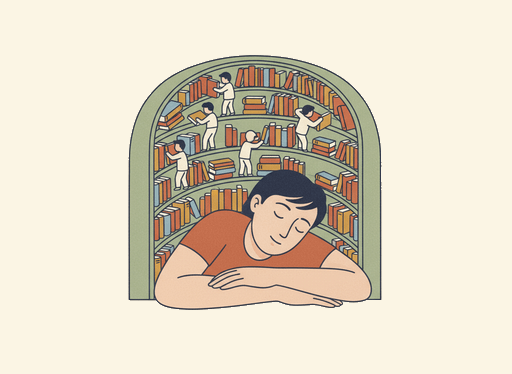
Particularly revealing is what happens in deep sleep. With electrodes one can observe that the same nerve cells that were active during learning fire again at night – in the same order, only faster. It is supposed that in deep sleep the brain (5) [replays] information, like an archive being sorted at night. What is important is transferred into long-term memory; what is unimportant is deleted or at least weakened. Without this nightly sorting, so the hypothesis goes, our memory would be overfull after a few weeks.
(6) [Although] the results are unambiguous, the question of the mechanism remains open. Why are some memories consolidated and others not? Emotional significance seems to play a role, as does the expectation of needing what was learnt later: someone who knows a test takes place the next day retains more than someone who was not told. The brain apparently (7) [decides] before falling asleep what it wants to keep.
For everyday life simple conclusions follow. Anyone who works through the night before an exam does themselves no favour; without sleep what was learnt is stored only poorly. It is more sensible to revise in the evening and then sleep. Even a twenty-minute nap can measurably improve learning performance – (8) [although] this has not yet got around in many schools and companies. Research, at any rate, agrees on one point: sleep is not lost time but the part of learning we can control least – and take least seriously.