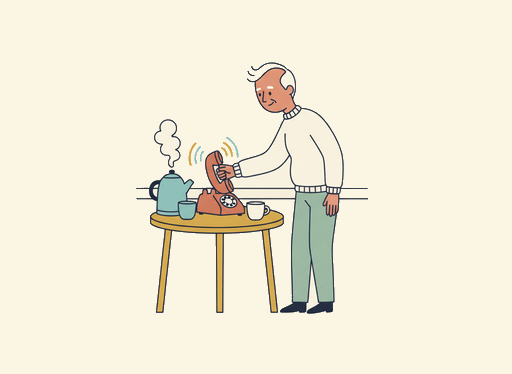
The water was already boiling when the telephone rang. Brenner let it ring. He knew it was Katrin. She had rung every Tuesday at half past seven since the funeral, and every Tuesday she asked the same thing.
He took two cups out of the cupboard. The white one with the crack in the handle he put beside the coffee machine; the blue one, which Ruth had always drunk from, next to it. Then he stood still, his hand still on the cupboard door. He did not put the blue cup back. In all those months he had never put it back.
The telephone fell silent. After a minute it rang again. He let it ring three more times, then he picked up.
"Dad, it's me. Have you looked at the flat?"
"Which flat?"
"The one in Lindenstraße. Two rooms, lift, balcony. I left you the note, remember."
The note lay on the kitchen table, under the sugar bowl. He had read it. Two rooms, he thought, that's enough for one. He said: "I'll take a look at it."
"You've been saying that since March."
"Then it's been true since March."
Katrin did not laugh. He heard her take a breath and then think better of it. She talked about the stairwell, about his knee, about the winter. He said yes and no and yes again, each time in the right places. He listened, looking out of the window at the courtyard, where the neighbour was rolling the bins out to the street, one after the other, as he did every Tuesday.
When he had hung up, he poured the coffee. Only into the white cup. The blue one stayed empty, as it stayed empty every morning, and yet he carried it to the table and put it at the place by the window. That was where Ruth had sat, for forty years, because she needed light in the mornings, as she used to say, and because she wanted to see who came into the courtyard.
He drank slowly. The coffee was too strong; he still made it the way she had liked it. Then he pulled the note out from under the sugar bowl and read it again. Lindenstraße 14, third floor, viewing Thursday, 4 p.m. Katrin had written "Dad, please" in the margin and underlined the "please" twice.
He folded the note and put it in the breast pocket of his shirt.
Later, while washing up, he held the blue cup under the warm water for a long time, although it was not dirty. He dried it, more carefully than the white one. Then he opened the cupboard, looked at the shelf where it used to stand, and closed it again.
He put the cup on the windowsill. From there, he thought, you can see the courtyard.