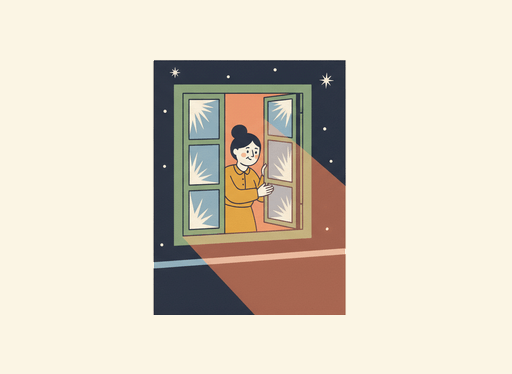
Every evening at nine my grandmother opened the kitchen window that looked out onto the street. She did it in summer, when the mosquitoes came in, and in January, when the frost stood on the panes and the heating fought against it in vain. She still did it when nobody had come for a long time. For a quarter of an hour the window stayed open; then she closed it, turned the latch twice and went to bed.
If you asked her why, she said: "So that the air doesn’t get used to the silence." She said it half in jest, with that lopsided smile with which she also claimed that her canary understood Polish. We children laughed, my mother rolled her eyes, and at some point nobody asked any more. The window belonged to her like the apron with the blue stripes and the rule that you never put a loaf on the table with its rounded side down.
The house had once been full. Seven children had grown up in it, and in the evenings neighbours had knocked at the window to borrow something, to tell a story, or simply because a light was still on. My grandfather had come up from the station every evening shortly after nine and, before unlocking the front door, had tapped on the pane. He died when my mother was twelve. The children moved away, to the city, to Canada, one even to Australia. The neighbours grew old or moved into care homes, and the renovated houses were taken by people who lowered their shutters in the evening.
My grandmother lived to be ninety-six. After her funeral my mother spent one more night in the empty house, because the dealer was to collect the furniture the next morning. Later she told me that at nine o’clock, without thinking about it, she had been standing in the kitchen, her hand already on the window latch.
Only at that moment did she understand that it had never been about the air. The window had not served for airing, but for waiting – not for a particular person, not even for grandfather, who had been dead for almost sixty years, but for the mere possibility that someone might pass by and knock. As long as the window stood open every evening, the house had not stopped being lived in; it was just that nobody happened to be there.
My mother opened the window that night and left it open for a quarter of an hour. The street was silent. Then she closed it and turned the latch twice.
Some gestures are sentences that cannot be spoken aloud without destroying them: whoever names their reason has already given them up.