A2.2 · 2 of 36
Wechselpräpositionen: Wohin?
Lesson · 4 rules · about 5 min
Put things somewhere and go places: draw an arrow of movement, and in, auf, an switch to the accusative — den, die, ins.
- You already know
- From "Wechselpräpositionen: Wo?": the nine prepositions with the dative for a position.
- New today
- The same nine with the accusative, when something moves: the putting verbs legen, stellen, setzen, hängen.
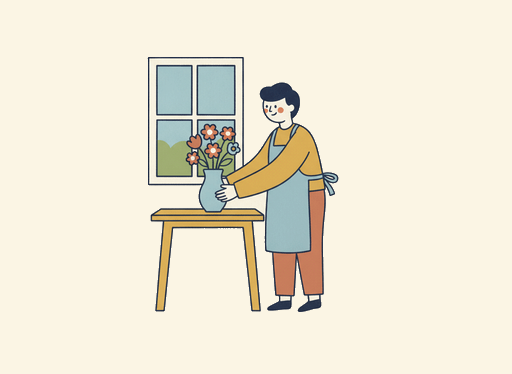
- 1Wohin? → Akkusativ: den / die / das
- 2legen / stellen / setzen / hängen — the putting verbs
- 3The cat jumps
- 4ins, ans, aufs
Why this matters
The same nine prepositions take the accusative when they answer wohin? — where to? — that is, when something moves towards a place: Ich lege das Buch auf den Tisch. Die Katze springt unter das Bett. Ich hänge das Bild an die Wand. The verbs on this side are the verbs of putting: legen (lay flat), stellen (stand upright), setzen (sit down), hängen (hang up), and the verbs of going: gehen, fahren, kommen, springen. Each position verb from the last quiz has a movement partner — liegen/legen, stehen/stellen, sitzen/setzen, hängen/hängen — and the pair tells you the case. With ins (in das), ans (an das) and aufs (auf das) you have the contractions of this side.
Rule · 1 of 4
Wohin? → Akkusativ: den / die / das
Something moves to a place: auf den Tisch, unter das Bett, an die Wand, in die Küche, ins Kino. Only the masculine changes visibly (den); die and das look like the nominative.
- auf auf den Tisch
- unter unter den Tisch
- in in die Kiste
- an an die Wand
- Ich stelle die Lampe auf den Tisch. I put the lamp on the table.
- Wir gehen ins Kino und dann in die Stadt. We're going to the cinema and then into town.
the arrow rule: if you could draw an arrow of movement, it is the accusative. 'Ich gehe im Kino' says you are walking around inside the cinema.
Quick check
Heute Abend gehen wir Theater. (We're going to the theatre tonight.)
Rule · 2 of 4
legen / stellen / setzen / hängen — the putting verbs
liegen ↔ legen (lie / lay), stehen ↔ stellen (stand / put upright), sitzen ↔ setzen (sit / seat), hängen ↔ hängen (hang / hang up). The second of each pair takes an object and the accusative.
| put it there (Akk) | now it is there (Dat) | |
|---|---|---|
| Ich lege das Buch auf den Tisch. | ⇄ | Das Buch liegt auf dem Tisch. |
| Ich stelle die Flasche auf den Tisch. | ⇄ | Die Flasche steht auf dem Tisch. |
| Ich setze das Kind auf den Stuhl. | ⇄ | Das Kind sitzt auf dem Stuhl. |
| Ich hänge das Bild an die Wand. | ⇄ | Das Bild hängt an der Wand. |
- Ich lege das Buch auf den Tisch. — Das Buch liegt auf dem Tisch. I lay the book on the table. — The book lies on the table.
- Ich hänge die Jacke in den Schrank. — Die Jacke hängt im Schrank. I hang the jacket in the wardrobe. — The jacket hangs in the wardrobe.
Quick check
Ich das Handy auf den Tisch. (I put the phone down.)
Memory trick · 3 of 4
The cat jumps
Die Katze springt auf die Box — moving, accusative. The arrow A→ is the A of Akkusativ.
- Wohin springt die Katze? – Auf die Box. Where does the cat jump? – Onto the box.
- Die Katze springt auf den Tisch. The cat jumps onto the table.
Quick check
Wohin läuft der Hund? – Unter Tisch. (der Tisch)
Rule · 4 of 4
ins, ans, aufs
in das → ins, an das → ans, auf das → aufs. Ich gehe ins Bett, ans Fenster, aufs Land.
- in+ das = ins ins Kino
- an+ das = ans ans Meer
- auf+ das = aufs aufs Dach
- Am Wochenende fahren wir aufs Land. At the weekend we're going to the countryside.
- Ich gehe jetzt ins Bett. I'm going to bed now.
Quick check
Wir setzen uns Fenster. (das Fenster)
Listen
Play it, then pick what you heard.
In context
Hear it in a real exchange
Ich räume auf: Ich lege die Bücher ins Regal und stelle die Tasse in die Küche. Die Jacke hänge ich in den Schrank, die Schuhe stelle ich unter das Bett. Dann setze ich mich auf das Sofa – fertig! Jetzt liegen die Bücher im Regal, die Jacke hängt im Schrank, und ich sitze auf dem Sofa.
I'm tidying up: I put the books on the shelf and put the cup in the kitchen. I hang the jacket in the wardrobe, I put the shoes under the bed. Then I sit down on the sofa – done! Now the books lie on the shelf, the jacket hangs in the wardrobe, and I'm sitting on the sofa.
Spot the mistake
Which one is right?
Spot the mistake
Which one is right?
Spot the mistake
Which one is right?
Cheat sheet
What to take with you
- Wohin? → Akkusativ: den / die / das
- legen / stellen / setzen / hängen — the putting verbs
- The cat jumps
- ins, ans, aufs
How to remember it
- Wohin? — an arrow — accusative: auf den, in die, ins.
- legen–stellen–setzen–hängen put things somewhere → accusative; liegen–stehen–sitzen–hängen say where they are → dative.
Put it there, then it is there · 4 rows
| Wohin? (Akk) — moving it | Wo? (Dat) — where it is |
|---|---|
| legen: Ich lege das Buch auf den Tisch. | liegen: Das Buch liegt auf dem Tisch. |
| stellen: Ich stelle die Vase ins Regal. | stehen: Die Vase steht im Regal. |
| setzen: Ich setze das Kind auf den Stuhl. | sitzen: Das Kind sitzt auf dem Stuhl. |
| hängen: Ich hänge das Bild an die Wand. | hängen: Das Bild hängt an der Wand. |
Wohin? (Akkusativ)
auf + Akkusativ
Ich lege das Buch auf Tisch. (der)
I put the book on the table.
More
Report a problem
Exercise
Wechselpräpositionen: Wohin? · A2.2
No single question is on screen — the report is about the whole exercise.
Reports go to the forum, where anyone can read them and the answer is kept for the next learner. To send one — and to be told when it is answered — sign in first. It takes one email, and no password.
Signing in lets us reply to your report, and shows you the answer the next time you are here. We email you a one-time link: no password, and nothing is shared with anyone.