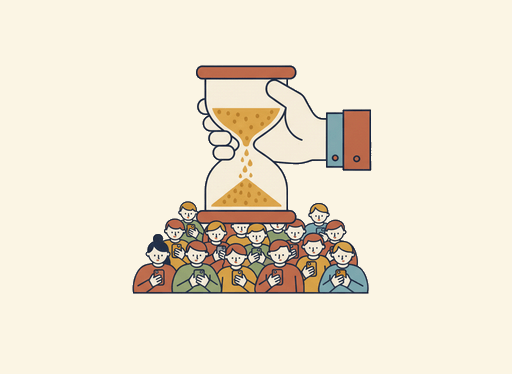
Attention has become the scarcest resource of our time. Whoever has it has power; whoever loses it disappears. [1] The platforms have turned this into a business model: every minute we spend on their pages is measured, sold and optimised. We are not the customers but the advertisers are; we are the goods. [2] The consequences are by now well documented. Studies show that the average time an adult works on a task without interruption has fallen dramatically in the last twenty years. Teachers report that young people hardly read longer texts to the end any more. [3]
One could object that nobody is forced to keep looking at their phone. Every person, so the argument goes, is responsible for their own behaviour; anyone who lets themselves be distracted simply lacks discipline. [4] Admittedly this objection is convincing only at first glance. The tools by which our attention is steered were designed by psychologists and tested on millions. Every colour, every vibration, every endlessly continuing scroll was optimised so that we stay. [5] Against such superiority no good resolution helps. It is hence not a matter of willpower but of rules – as with tobacco or gambling. There too people long relied on the individual's reason before realising that it is not enough on its own.
What would such rules be? Some countries have begun to ban phones from classrooms; first evaluations point to better performance and fewer conflicts. Others are discussing a ban on the automatic continuation of videos or an age limit for social networks. [6] They intervene in a market that was almost unregulated until now, and they demand that companies forgo profit. Nonetheless the question remains who should set these rules – the state, the platforms themselves or an international authority that does not yet exist. Each of these answers has drawbacks: the state is slow, the platforms are a party to the matter, and an international authority would first have to be laboriously negotiated.
At the end stands a simple observation. A society that no longer determines its own attention can no longer decide freely about anything else either. [7] Whether we want that is not a technical but a political question – and it brooks no delay.