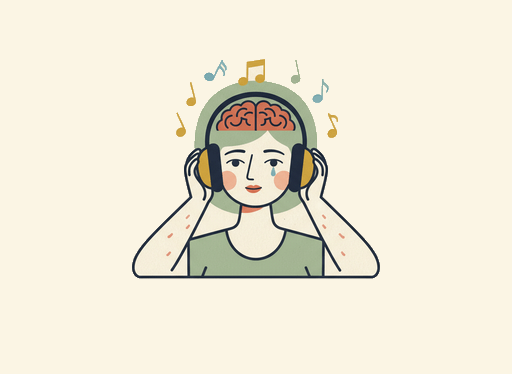
Why does music move us so strongly? A three-minute song can wake a memory twenty years old, can produce goosebumps or tears – and that in people who have no idea of harmony theory. Neuroscience has been trying for about two decades to track this phenomenon with imaging methods, and some of its findings are now well established while others remain supposition.
What is certain: music does not activate a single "music centre" but a network. Researchers suppose that music activates several areas of the brain simultaneously, among them those responsible for movement, for language and for emotions. That the auditory cortex is involved surprises nobody; what is remarkable is rather that motor areas also fire, even when the subject lies still. That explains why we almost involuntarily tap our foot to a rhythm.
Interestingly, the brain releases dopamine – much as when eating a favourite dish. This messenger belongs to the reward system, which also responds to food, money or social recognition. A Canadian research group was able to show that the release does not begin at the moment of the musical climax but a few seconds before: the brain apparently rewards the expectation. Someone who knows a piece looks forward to the passage that is about to come – and precisely this anticipation seems to be an essential part of the pleasure.
Astonishingly, the effect also appears in people who never learnt an instrument. Musical training does strengthen the reaction but is not a precondition for it. That argues against the assumption that the pleasure in music is above all a learnt, cultural phenomenon. It does not work entirely without culture, admittedly: which sounds are felt to be pleasant differs markedly between societies.
Practical applications follow from these findings. Music is used in pain therapy because it binds attention; in rehabilitation after strokes because rhythm supports movement planning; in dementia care because familiar songs reach memories that are no longer accessible through language. This field will probably grow in the coming years.
However, caution is required. Most studies work with small groups and with Western music; whether their results can be generalised is open. And that music releases dopamine says nothing yet about why one particular song moves one particular person to tears. Research here is only at the beginning – and music is, as so often, a good way ahead of it.