Feature: Die Stunde vor dem Morgen
Press play and listen as many times as you like — the transcript appears once you check your answers.
C2.1 · 11 of 30
Lesson · 3 rules · about 3 min
Ein Radiofeature von etwa 450 Wörtern, literarische Reportage, nur einmal zu hören, über die Stunde vor der Morgendämmerung in einer Großstadt. Ein Feature überzeugt durch Bilder, die Fragen zielen also sowohl auf das, was geschieht, als auch auf die Wirkung der Sprache. Es beginnt damit, ein Klischee im Konjunktiv I zu widerlegen (Wer glaubt, eine Großstadt schlafe nie, der irrt.), folgt dem Reporter durch die stillen Straßen, lässt einen Nachttaxifahrer in indirekter Rede zu Wort kommen und kehrt am Schluss zu einem gewöhnlichen Arbeitsmorgen zurück. Achte auf die Personifikationen, also Dinge, die wie Lebewesen handeln (Die Häuser haben ihre Augen geschlossen.), auf die Vergleiche mit wie (gewissenhaft wie Beamte, wie ein Aquarium auf Schienen), auf die Metaphern (eine kleine Insel in einem Meer aus Dunkelheit) und auf die genauen Zahlen und Uhrzeiten, die die Fragen gern verdrehen.
Press play and listen as many times as you like — the transcript appears once you check your answers.
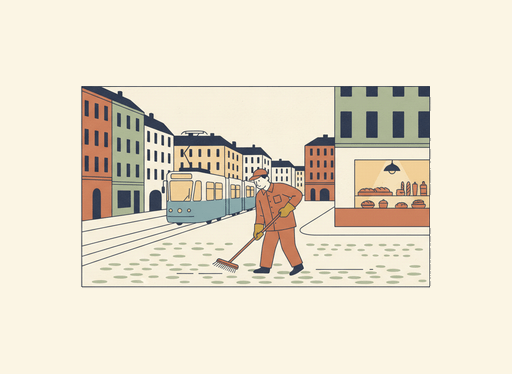
Anyone who believes a big city never sleeps is mistaken. There is this one moment, just before dawn, in which even the restless metropolis seems to hold its breath. I looked for it for three nights, between the main station and the harbour, and on the fourth I found it. It is just after four. The last night owls have vanished, the first early-shift workers are not yet on their way. There is nobody on the bridge over the canal except me. The traffic lights switch from red to green and back again, conscientious as civil servants whom nobody has told that no one is coming any more. The silence lies over the streets like a cloth, and yet it is not empty. Somewhere a refrigeration unit hums, a pigeon scratches on a window ledge, warm steam rises from a drain. The houses have closed their eyes. Only here and there is a window still lit – a student before an exam perhaps, a nurse who has just come home, an old man who can no longer sleep. Each of these lights is a little island in a sea of darkness, and for a moment it seems to me as if they were the city’s real guardians. Ms Demir, who has driven a taxi at night for nineteen years, knows this hour well. She calls it “the pause”. At this time, she says, the city belongs to nobody, neither to those who are partying nor to those who are working. You can hear the paving stones cooling down then. She laughs as she says it, as if she were embarrassed to say such a thing out loud. But she means it. In the past, she says, she often stopped at this hour and simply wound down the windows. Today she does that less often; the nights have become shorter, the shifts longer. The pause does not last long. Towards half past four the first tram rumbles out of the depot, still almost empty, brightly lit like an aquarium on rails. A delivery van stops outside the bakery on the corner, crates are unloaded, a door slams. In the east the sky above the harbour cranes turns first grey, then pale pink. The city breathes out again. You notice it in small things. The first joggers do their rounds along the canal, in a back courtyard a roller shutter is pulled up, and the clatter of dishes comes through a tilted window. Nobody seems to notice that something has just come to an end. I walk back to the tram stop. Next to me a man in an orange work jacket is waiting; he yawns and looks at his phone. He has no eye for the sky, and why should he? For him this is not a special moment but a perfectly ordinary Tuesday. The tram comes, we get on, and the city is once again what it is most of the time – loud, hurried and a little indifferent. Perhaps that is exactly how one has to love it.
Exercise
Hören: Feature · C2.1
No single question is on screen — the report is about the whole exercise.
Reports go to the forum, where anyone can read them and the answer is kept for the next learner. To send one — and to be told when it is answered — sign in first. It takes one email, and no password.
Signing in lets us reply to your report, and shows you the answer the next time you are here. We email you a one-time link: no password, and nothing is shared with anyone.
Everything works without an account. Signing in backs your progress up, carries it to your phone, and lets you post on the forum.
One email, no password. We email you a one-time link: no password, and nothing is shared with anyone.