Vortrag: Das Gedächtnis – Archiv oder Erzähler?
Press play and listen as many times as you like — the transcript appears once you check your answers.
C2.2 · 6 of 34
Lesson · 4 rules · about 4 min
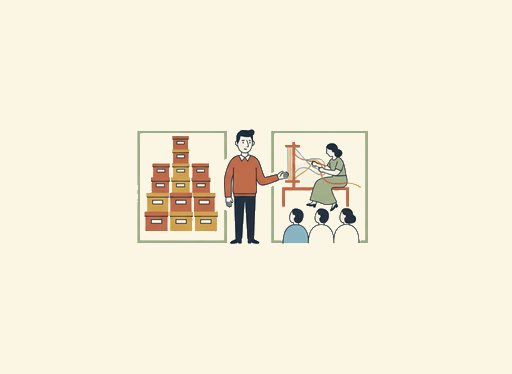
Ein Fachvortrag über das Gedächtnis (etwa 470 Wörter, einmal gehört), der ein Modell durch ein anderes ersetzt. Er beginnt mit der alten Sicht: „Lange Zeit stellte man sich das Gedächtnis wie ein Archiv vor“, verwirft sie mit „Diese Vorstellung gilt heute als überholt.“ und führt mit dem korrigierenden vielmehr die neue ein: „Vielmehr deutet die Forschung darauf hin, dass eine Erinnerung bei jedem Abruf für kurze Zeit wieder instabil wird und anschließend neu gefestigt werden muss.“ Es folgen drei namentlich genannte Quellen (Frederic Bartlett, Karim Nader und Kollegen, Elizabeth Loftus), dann eine vorsichtige Übertragung auf den Menschen, eine neue Metapher (der Erzähler) und der Schluss „Erinnern ist demnach kein Abrufen, sondern ein Erzählen.“ Hör auf zweierlei: auf die Wegweiser der Argumentation und auf den Modus der Verben. Forschungsergebnisse nennt der Sprecher im Indikativ; den Konjunktiv I verwendet er nur dort, wo er wiedergibt, was ein namentlich genannter Forscher vertrat.
Press play and listen as many times as you like — the transcript appears once you check your answers.
Ladies and gentlemen, let me begin with an image that is probably familiar to all of you. For a long time memory was imagined as an archive: an experience is stored away, given a label and, when needed, brought out again unchanged. In this model forgetting appeared as mere loss – as a misplaced or yellowed file. The metaphor is so catchy that it still shapes our everyday language: we "store" memories and "retrieve" them. This idea is now regarded as outdated. Rather, research indicates that a memory becomes unstable again for a short time each time it is retrieved and then has to be consolidated anew. In this context one speaks of reconsolidation. The idea is not entirely new, however. As early as 1932 the British psychologist Frederic Bartlett held the view that remembering is not reproduction but reconstruction; people fill gaps with whatever seems plausible to them. Bartlett had his participants retell a North American folk tale several times and observed how, with each retelling, they adapted the unfamiliar story more closely to their own expectations. His thesis nevertheless long remained an outsider position because it lacked a neurobiological explanation. That explanation has only been emerging for about two decades. In 2000 the neuroscientist Karim Nader and his colleagues showed in rats that an already consolidated fear memory can be lost if the formation of new proteins in a particular brain region is inhibited immediately after the memory has been retrieved. The authors concluded that a memory is not definitively secured even after years; it has, as it were, to be rewritten every time it is retrieved. What follows from this for human beings? Caution is called for here, because findings from animal experiments cannot simply be transferred. There is, however, some evidence that the principle is at work in us too. The American psychologist Elizabeth Loftus has shown in numerous experiments how easily memories can be altered by information supplied afterwards. People who, after watching a filmed traffic accident, were asked how fast the cars were going when they "smashed into" each other estimated the speed higher than those who were given the neutral "collided" – and a week later more often reported having seen broken glass that did not appear in the film at all. The result is a picture that has little in common with the archive. A more apt comparison would probably be with a storyteller who tells a story a little differently every time – depending on who is listening and what he has experienced in the meantime. This expressly does not mean that our memories are worthless. The broad outlines are as a rule preserved; what becomes unreliable are above all details, of the kind that matter in court, for example. Remembering, then, is not retrieval but narration. And perhaps precisely this is not a defect but an advantage: a memory that adapts keeps us capable of acting in a world that is constantly changing. We should, however, stop trusting a memory simply because it is vivid.
Exercise
Hören: Fachvortrag · C2.2
No single question is on screen — the report is about the whole exercise.
Reports go to the forum, where anyone can read them and the answer is kept for the next learner. To send one — and to be told when it is answered — sign in first. It takes one email, and no password.
Signing in lets us reply to your report, and shows you the answer the next time you are here. We email you a one-time link: no password, and nothing is shared with anyone.
Everything works without an account. Signing in backs your progress up, carries it to your phone, and lets you post on the forum.
One email, no password. We email you a one-time link: no password, and nothing is shared with anyone.